
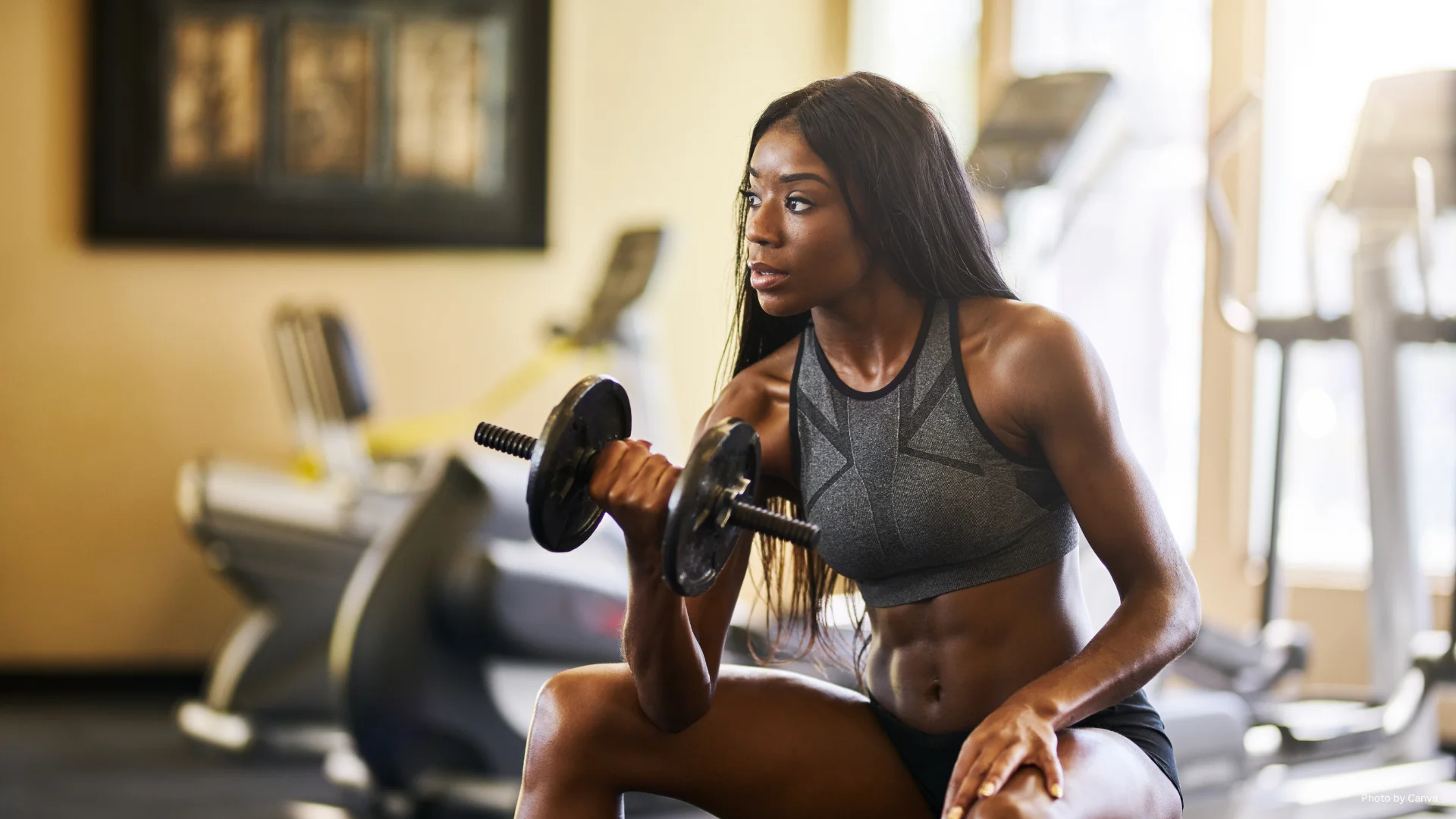
The woman at the squat rack had already moved once. She had set up in the corner where the mirrors end, loaded the bar, and started her second set when a man in a cutoff shirt drifted over to tell her that her hips were shooting up too fast. He was not wrong about the hips. He was also not asked, and by the time he finished explaining, she had racked the weight and walked her session over to the platform on the far wall, where she finished alone and left twelve minutes early.
That small migration happens thousands of times a day in American gyms, and it is the single most useful thing to understand before you consider talking to anyone in one. Approaching someone at the gym is not forbidden, and it is not doomed, but the odds sitting across from you are not the odds you think they are. Most women in a weight room have already been spoken to today, or yesterday, and almost none of those conversations were the one they wanted.
Researchers at the SHE Research Centre in Ireland and the University of the West of England surveyed 279 women about what actually happens to them in gym settings, and published the results in PLOS ONE in January 2025. Seventy-one point nine percent reported receiving unsolicited comments from men. Forty-six point six percent had been complimented on their appearance without inviting it. Thirty-nine point two percent said they felt more intimidated exercising around men, and forty-one point four percent said they thought about potential dangers when choosing what to wear to train.
The numbers describe a tax, not a mood
It is tempting to read those figures as a report on feelings, and that reading misses what the data is measuring. A separate survey of 3,774 gym members conducted by RunRepeat in June 2021 found that 56.37 percent of the women in its sample had experienced harassment while working out, against 21 percent of the men. What happened next is the part worth sitting with. Just over thirty percent of harassed members changed their routines or started avoiding certain areas of the building, roughly a quarter stopped going or switched gyms entirely, and 92.31 percent of the incidents involving women were never reported to anyone.
The cost is a training plan quietly rewritten around where a stranger is standing, which is why the woman at the rack finished on the platform instead of the corner, and why she will probably come in at a different hour next week.
Emma Cowley and Jekaterina Schneider, who ran the PLOS ONE study, put the bind plainly in a statement accompanying the research: "In the gym, just like in other areas of life, women often feel stuck between being seen as 'too much' and 'not enough', dealing with judgement about how they look, how they perform, and even how much space they take up." One participant, asked what she experienced most often, wrote four words that do more work than any statistic: "Men getting in my personal space when exercising."
An approach and an interruption look identical from the outside
Every one of the failure modes in that research shares a shape, which is that the woman was mid-effort, cornered by equipment or a mirror, and handed a conversation she had to negotiate her way out of while her heart rate was still coming down.
Timing carries almost all the weight
Between sets is not a break. It is the most protected ninety seconds in the session, and the reason someone is staring at nothing during it is that a working set is coming. The window that actually exists is the one after the last set, at the water fountain, in the stretching area, on the way out the door, when the training is finished and the person is already transitioning back to the rest of their day. If you cannot tell whether someone is done, they are not done.
The exit has to be free before you open your mouth
Stand where the person can walk past you rather than around you. Say one thing, make it short, and let a flat answer end it. A woman who says "thanks" and turns back to her phone has given you a complete response, and the men who generate the numbers above are the ones who treat that response as an opening line rather than a closing one. Unsolicited coaching is the worst version of this, because it opens with a correction and then requires her to manage your feelings about being corrected in return.
Say something about the room, not about her body
Forty-six point six percent of those women were complimented on how they looked. That is the single most common thing men say in gyms and it is the single least effective, because it announces that she was being watched while she worked. The alternative is not complicated. Ask if she is using the bench. Ask how many sets she has left. Ask whether the Friday class is worth showing up for. These are questions with real answers, they can be answered in four words, and none of them require her to decide what you meant.
If the whole exchange never turns into anything, that is a normal outcome and not a failed one. Regulars recognize each other over months, and the fourth short conversation lands very differently from the first, because by then you are a person she has seen deadlift rather than a person who materialized behind her.
The rooms where this is already easier
There is a reason so much of modern athletic dating has migrated toward formats with a built-in reason to talk. Run clubs solved the problem structurally, by putting strangers side by side, facing the same direction, with a shared pace and a fixed end point, which is why run clubs became the default meeting ground for people who had given up on swiping. Group classes and climbing sessions do the same work. Partner drills, belay checks and shared equipment all create a legitimate opening that nobody has to invent.
The same logic explains why the wellness date replaced the standing drinks invitation. A run, a class, or a Saturday hike gives both people a task, a duration and an obvious end, and none of that is available to a man walking across a weight room floor with nothing in his hands.
What the numbers ask of everyone else in the building
The 92.31 percent figure is the one gym operators should read twice. Harassment that is never reported does not appear in an incident log, which means a facility can run for years believing it has no problem while a quarter of its female members quietly relocate or cancel. Staffed floors, visible reporting paths and a posted policy do more for that number than any campaign about respect, because they change what happens after the moment rather than asking people to be different during it.
For everyone else, the useful move is smaller and immediate. Notice when someone has moved their setup twice. Notice when a conversation at the cable machine has one participant with her body angled toward the exit. Standing nearby, or asking her if she needs the station you are clearly not using, ends more of these than any confrontation would.
The best version of this is boring
Nobody meets anyone in a gym through a great line. They meet through repetition, minimal interference, and the accumulated evidence that they are safe to be around. The men who date people they met training are almost always the ones who spent three months being unremarkable first, and the intimidation that keeps so many people out of these rooms in the first place is worth taking seriously too, which is why low-barrier entry points into a practice tend to produce more consistent training than any amount of nerve.
Train. Put your weights back. Say one short thing when someone is clearly finished, and accept whatever comes back. The woman on the far platform is not looking for a reason to say no. She is looking for a room where she does not have to keep deciding.