
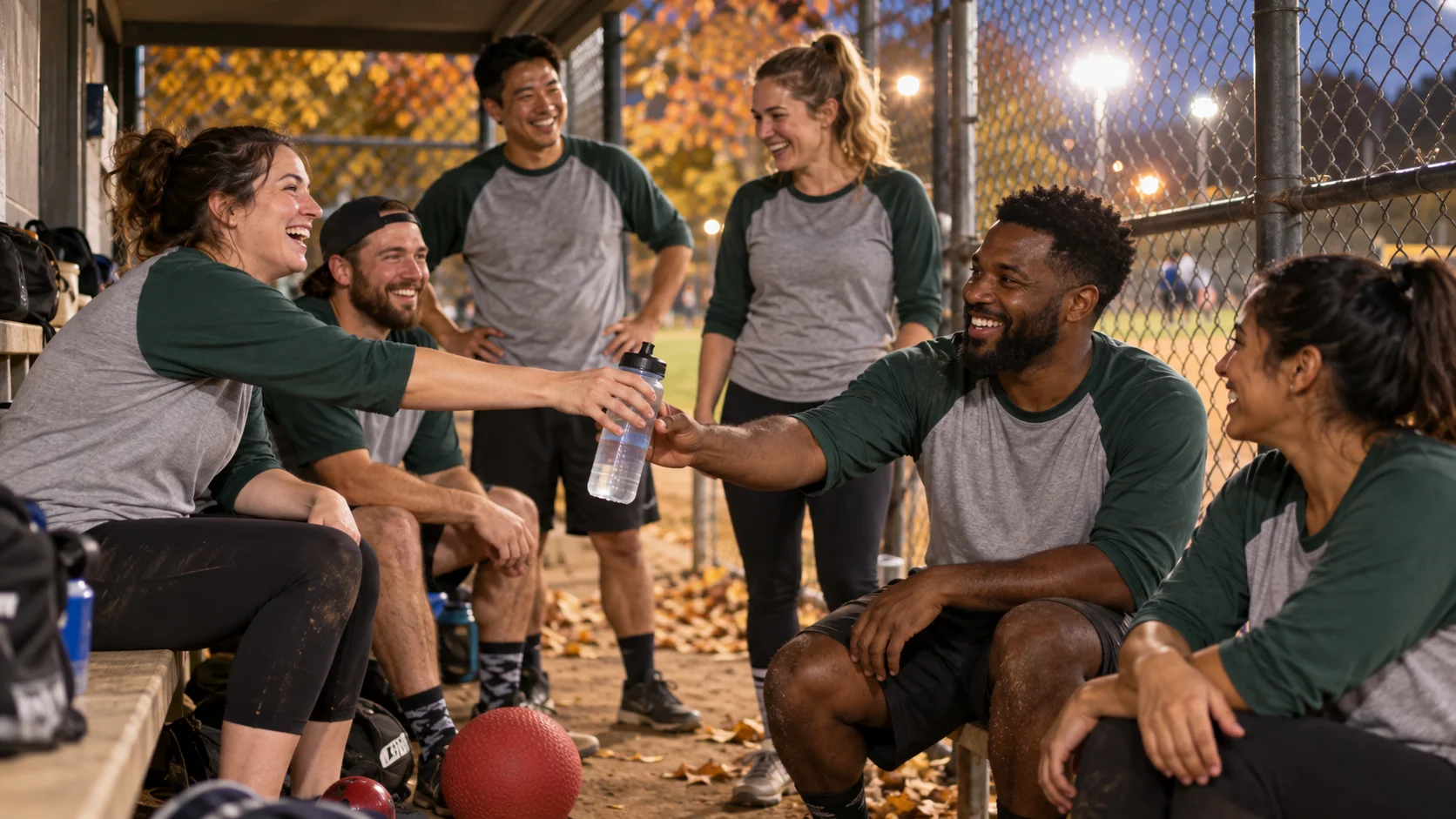
The first night of a fall coed kickball league tends to look the same in every city: thirty-odd adults in matching jerseys who mostly do not know one another, a referee with a whistle, a bar booked for afterward, and a schedule that promises the same people in the same place every week until the weather turns. Nobody in that group signed up for a date, and that may be exactly why the league works as well as it does.
The short answer for anyone weighing a fall season is that coed rec leagues manufacture the conditions under which people come to like each other: repeated contact, a shared task, and enough hours that familiarity has time to become something warmer. Relationship science has been describing those conditions for more than seventy years, long before anyone sold league registrations online.
The founder of the largest company in the business met his wife in one of his own leagues, playing bocce. "We call ourselves a genuine human interaction company," Giovanni Marcantoni, the CEO and founder of Volo Sports, told PitchBook in November 2025. "Our part-time staff, our players, pretty much everyone meets their significant other through this."
The Hallway Study That Explains the Kickball Field
In the years after World War II, the social psychologists Leon Festinger, Stanley Schachter and Kurt Back studied how residents of the married-student housing at MIT chose their friends, and the answer had less to do with shared tastes than with floor plans. Ties were predicted by propinquity, the plain physical closeness of where people lived, and by how often their daily routes crossed.
The numbers that came out of that work still show up in introductory psychology courses. As the University of Michigan social psychologist Amie Gordon summarized them in Psychology Today, 41 percent of residents were friends with the person next door, fewer than 25 percent with someone a few doors down, and only 10 percent with someone at the end of the hall.
A league roster recreates that hallway on purpose. The same twelve people stand in the same dugout every week, wait in the same line for the same pitch, and walk to the same bar when the game ends, which turns strangers into the person next door for an hour or two at a time.
Familiarity Does the Slow Work
Robert Zajonc gave the mechanism a name in 1968. His monograph in the Journal of Personality and Social Psychology proposed that "mere repeated exposure of the individual to a stimulus is a sufficient condition for the enhancement of his attitude toward it," and decades of follow-up studies have found that people tend to warm to faces, sounds and words simply by encountering them more often, as the original paper lays out.
The mere-exposure effect is modest on any single night, which is the point. A first date asks two people to form a verdict in ninety minutes, while a nine-week season lets the verdict form on its own, somewhere between the third week when names finally stick and the sixth week when someone saves you a seat.
That slower clock also lowers the cost of a bad night. A dropped fly ball or an awkward joke in week two gets absorbed into a season of other moments, whereas the same stumble across a restaurant table can end the whole acquaintance.
The Fifty-Hour Rule
Jeffrey Hall, a professor of communication studies at the University of Kansas, tried to put numbers on the clock. His research, published in the Journal of Social and Personal Relationships, found that it takes roughly 50 hours together to move from acquaintance to casual friend, about 90 more hours to reach friend, and more than 200 hours before someone becomes a close friend, according to the university's account of the study.
"We have to put that time in," Hall said. "You can't snap your fingers and make a friend."
One line in the paper's abstract reads almost like a recruiting pitch for fall leagues: "Hours together was associated with closer friendships. Time spent engaging in leisure activities also predicted closeness," Hall wrote in the 2019 paper. A weekly game plus the hour that follows it adds up to roughly twenty-five hours across a typical season, which gets a roster halfway to that first threshold before the playoffs.
Where Couples Used to Meet
For most of the twentieth century, Americans met their partners through people they already knew. In the nationally representative survey behind a 2019 PNAS paper by the Stanford sociologist Michael Rosenfeld and his co-authors, meeting through friends accounted for 33 percent of heterosexual couples in 1995 and 20 percent by 2017, as the study's tables show.
A rec league rebuilds that older route in a new form. The teammate who invites a friend to fill in for a missing player, the opposing captain who ends up at the same table after the game, and the free agent placed on a roster by the league office all produce the friend-of-a-friend introductions that used to come from church, school and the neighborhood.
How Big the Social Sports Business Has Become
The industry built around that idea has grown large enough to consolidate. Volo told PitchBook that it had received more than 750,000 player registrations across more than 4,500 leagues so far in 2025, a figure that counts sign-ups rather than unique players. In June 2025, Volo announced it was acquiring ZogSports, which it described in a company release as the country's second-largest social sports platform with more than 120,000 players, bringing the combined company to 11 major cities.
The broader trend runs in the same direction. The Sports and Fitness Industry Association reported that team sports posted the strongest year-over-year growth of any category in 2025, passing 90 million total participants for the first time, according to SGB Media, although that count covers players of every age rather than adults alone.
Marcantoni describes his own start in terms any newcomer to a city would recognize. "I didn't know anybody," he told PitchBook. "I played in kickball, flag football and softball, and that's how I made friends."
Why Shared Effort Helps
A league also supplies something a dinner reservation cannot, which is a common problem to solve. The psychologist Arthur Aron and his colleagues ran a series of studies, published in 2000, in which couples who completed a seven-minute novel and physically arousing task together reported larger gains in relationship quality than couples given a mundane task, according to the published paper.
Those participants were existing couples rather than strangers, so applying the finding to a coed volleyball team stretches it beyond what the researchers tested. Even so, the shape of the experience is familiar to anyone who has chased a loose ball with a teammate, celebrated a lucky rally or argued good-naturedly with a referee in the last inning.
Making a Season Count
The practical advice follows from the research rather than from any dating playbook. Pick a league that meets weekly on a night you can protect for the whole season, because the benefit compounds only if you keep showing up, and choose a format with a built-in social hour so the contact continues after the final whistle.
Signing up as a free agent is less risky than it sounds, since leagues routinely place solo players on rosters that need numbers, and arriving without a group forces the introductions that a ready-made team of old friends would let you skip. Low-skill formats such as kickball, bowling and casual volleyball tend to keep the stakes low and the conversation easy, which is useful for anyone whose idea of a date that won't be awkward involves a ball and a scoreboard.
Treat the first few weeks as friendship time rather than as a search. The research on propinquity and exposure describes liking that builds gradually, and the person worth asking out in week seven will usually be easier to spot than anyone who stood out on opening night.
Players who already run, walk or play pickleball can layer a league on top of habits they have, the way the pickleball court became a fixture for active singles this year. The difference is the roster, which guarantees the same faces return every week.
By the last game of the fall, a player who arrived as a stranger in September has logged something like twenty-five of those first fifty hours with the same group. If the league runs a winter session indoors, the rest of them are one registration form away.