At 9 a.m. sharp on Thursday, November 26, a little more than 14,000 people will crowd Delaware Avenue in Buffalo for the 131st consecutive start of the YMCA Turkey Trot, a race its organizers bill as the oldest consecutively run footrace in the world. Some of them will be chasing a time over the 8-kilometer course. A good share will be walking, pushing strollers, wearing pilgrim hats, and introducing someone new to a brother-in-law somewhere around the second mile.
Thanksgiving is the biggest race day in American running, and it also happens to be the day when many new couples face their first holiday with each other's families. Put those two facts side by side and the Turkey Trot date starts to look less like a novelty and more like the smartest piece of holiday planning a new relationship can do.
The short version for anyone deciding before registration closes: signing up together for a Thanksgiving morning race gives a new partner a shared goal, a defined end point, and a low-pressure way to spend time with the people whose opinion of the relationship research says matters more than most couples admit.
The Numbers Behind America's Biggest Running Day
RunSignup, the registration platform used by a large share of community races, counted 1,330,726 registrations across 1,056 Thanksgiving races on its system in 2025, according to the company's own year-end tally. That figure was up 20 percent, or 220,817 people, from the previous record set on Thanksgiving 2024, and 389 of those races drew more than a thousand participants each. Those are registrations on one platform rather than a census of every finish line in the country, so the true national number runs higher.
The Dallas YMCA Turkey Trot began in 1967 with 107 runners on a 3-mile course and now draws more than 20,000 participants across a 5K and a 10K, along with thousands of spectators. In Connecticut, the Manchester Road Race starts at 10 a.m. on Thanksgiving over a 4.737-mile course, and its homepage lists a participant count above 10,500. Buffalo's field of more than 14,000 includes runners, joggers, and walkers, with a dedicated run/walk pack and a trail bus that collects anyone who decides partway through that pie sounds better than mile four.
What these races share is a format built for mixed company. Nobody at a Turkey Trot expects a first-time participant to run fast, and the costume quotient alone makes it hard for anyone to take the clock too seriously. The Dallas race once set a Guinness record for the most people dressed as turkeys, which tells you most of what you need to know about the prevailing mood.
Why Meeting the Family Matters More Than It Feels Like It Should
Couples tend to believe their relationship is their own business. A long line of social science suggests otherwise. In a study that followed 101 couples from 1988 to 1990, sociologists Susan Sprecher and Diane Felmlee found that the support partners felt from family and friends was tied to satisfaction, love, and commitment, and it predicted whether couples were still together at the end of the study. Felmlee, then at the University of California, Davis, put the finding plainly in the university's announcement.
"This research suggests that in spite of what we think, social networks may have a big effect."
Felmlee returned to the question in a 2001 paper in Social Forces that tracked the pace at which relationships end. Approval from friends and from a partner's family slowed that pace, which is about as direct a case as the literature offers for taking the holiday introduction seriously. Later work complicated the popular "Romeo and Juliet effect," the old idea that parental disapproval drives couples closer. Researchers led by H. Colleen Sinclair reported in a 2014 paper in Social Psychology that participants who perceived lower approval from their networks described poorer relationship quality, not stronger bonds.
None of this means a single Thanksgiving makes or breaks anything. It does mean the first meeting carries more weight than an ordinary dinner, and that the setting deserves some thought. A three-hour sit-down with forty minutes of small talk before the turkey is carved is a hard format for anyone. A race morning is easier, because the event itself supplies the conversation.
Why a Race Beats the Dinner Table for a First Meeting
A Turkey Trot gives everyone something to do with their hands and their attention, and it hands the new person an instant role as a teammate in a family ritual rather than a guest under evaluation. Waiting in the start corral produces twenty minutes of easy chatter about shoes, weather, and who is wearing the most ridiculous hat, which is the kind of conversation that lets an uncle learn something about your partner without either of them feeling interviewed.
The race also has a defined shape. It starts at a known time, it ends at a finish line, and it usually lands everyone back at the house with a few hours to spare before dinner, which gives the newcomer an early win before the longer social stretch of the day. Readers who have followed our coverage of why run clubs became a meeting ground for singles will recognize the mechanism, since shared movement lowers the stakes of conversation in a way that a restaurant booth rarely manages.
For couples who are not meeting family yet, the case still holds. Thanksgiving morning is a natural first holiday plan for a relationship that is a month or two old, because it is lighter than an invitation to dinner and it leaves both people free to go home to their own tables afterward. Couples who spent the fall chasing a goal race, the subject of our look at what marathon training does to a relationship, can treat it as a celebratory lap rather than a test.
How to Plan a Turkey Trot Date Without Making It Weird
Start with registration, because popular races fill or raise prices as the day approaches, and Thanksgiving falls just under three weeks from today. Pick the shortest distance on offer if either person is new to racing, since a 5K walked at a conversational pace takes most people under an hour and keeps the morning about company rather than suffering. If the family already has a tradition, ask about it before suggesting an alternative, because inserting yourself into an existing ritual lands better than inventing a new one.
Agree on pace before the gun goes off. Mismatched speed can sour a shared run within the first mile, and the simplest fix on race day is to declare it a walk, a jog, or a run in advance and hold to it. If one partner is fast and wants a time, the other can join the walkers with the family and meet at the finish, which also gives your partner some unhurried time with their relatives while you are out on the course.
Dress for standing around, since the cold arrives before the start rather than during the race. A throwaway layer, gloves, and a hat cover the corral, and in northern cities the late-November morning can sit near freezing. Plan breakfast lightly, because the larger meal of the day is coming, and bring something warm to change into for the drive back.
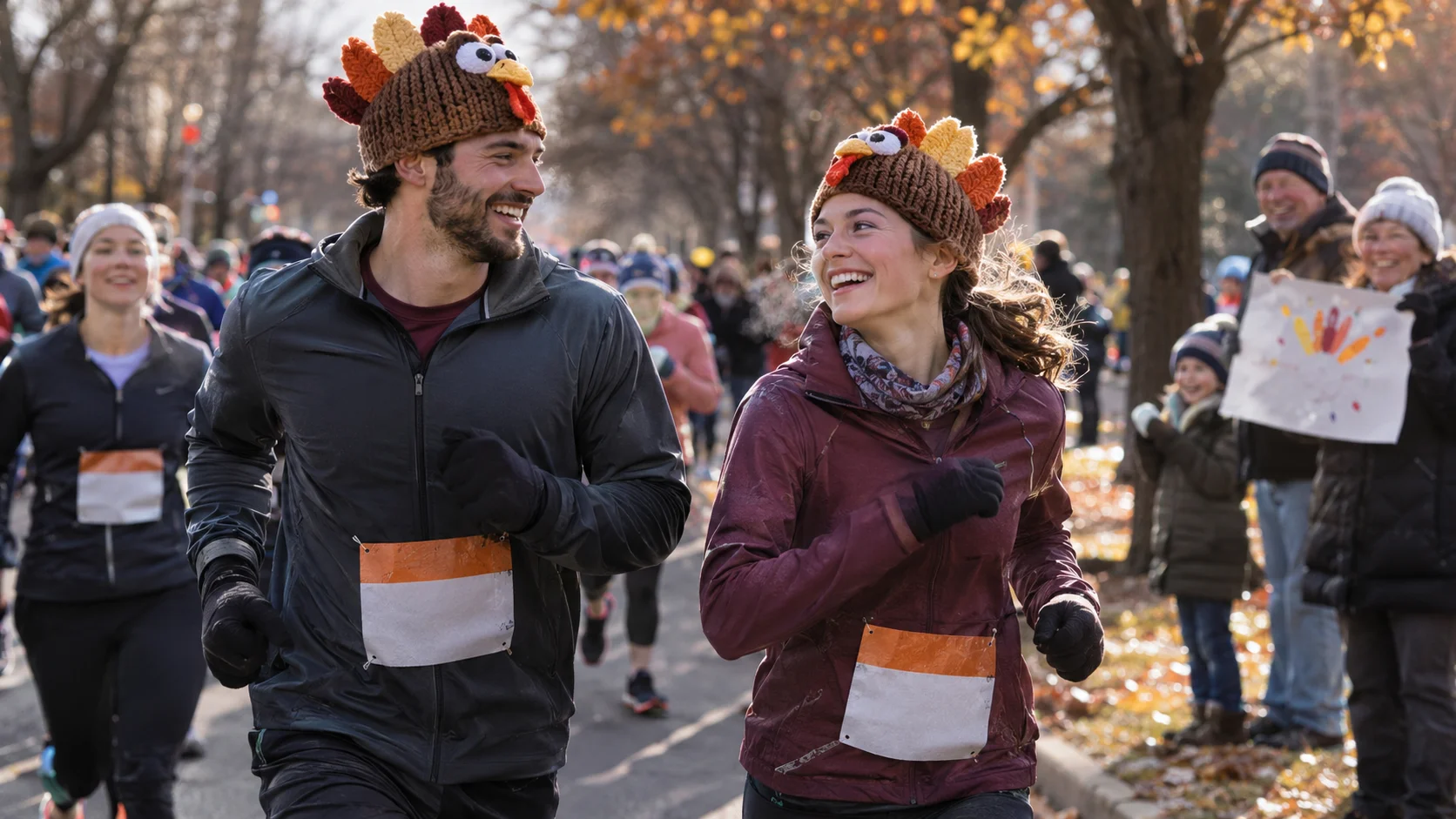
A matching pair of turkey hats reads as playful at a race where thousands of strangers are doing the same thing. Showing up in full costume when your partner's family arrives in plain running jackets reads differently, so a quick text the night before about what everyone usually wears saves an awkward photo.
What to Do When the Family Does Not Run
Plenty of families treat Thanksgiving morning as a parade-and-coffee affair, and a race invitation can land as a judgment if it is pitched badly. Frame it as an optional plan for the two of you, invite anyone who wants to walk, and offer to be back in time to help with the cooking. Most Turkey Trots welcome spectators along the course, and a relative who stands at the halfway point with a sign is participating just as fully as one who runs.
If the race is in your partner's hometown, let them choose the event and the meeting point. That keeps the newcomer in the position of guest and gives your partner the pleasure of showing off a local tradition, which is often the most comfortable way to bring someone into a family's orbit.
After the Finish Line
The race is a warm-up for the day, and the hours that follow matter too. Offer to help in the kitchen, ask the person who has run the most Turkey Trots in the family to tell you about the worst weather they ever raced in, and let the finish-line photo do some of the social work, since nothing breaks the ice at a dinner table like a picture of everyone in matching hats.
The approval research is not a reason to perform for anyone. It is a reason to make the first meeting easy, and a 5K on a cold Thursday morning, with fourteen thousand strangers in Buffalo or a few hundred in your own town, is about as easy as a family introduction gets. With sunset now arriving before most people leave work, a plan built around morning daylight has its own appeal.
Buffalo's start goes off at 9 a.m. Manchester's follows at 10. Most of the other thousand-plus races fall somewhere in that window, which leaves plenty of time to get home, shower, and sit down at the table together.