Somewhere between the Thanksgiving leftovers and the first December office party, a person who has been dating someone for six or seven weeks will open a shopping app, scroll past a smartwatch and a set of resistance bands, and freeze over a question no checkout page can answer. The question is not what the new partner would like, because almost anyone would like a nicer water bottle, but what a gift at this early stage is supposed to say about where the two of them are headed.
Black Friday lands on November 27 this year, which means the window for that decision is already open, and the research on gift giving offers a clearer answer than the retail calendar does. Over the past decade, consumer psychologists have tested what kinds of presents actually bring people closer, and the results point away from the gear aisle and toward the calendar, especially for couples who already organize their weekends around a run, a climb or a class.
The most cited work comes from Cindy Chan of the University of Toronto Scarborough and Cassie Mogilner of UCLA Anderson, who published a set of four studies in the Journal of Consumer Research in December 2016. Their finding, as the University of Toronto summarized it, was that experiential gifts did more to strengthen relationships, from the recipient's point of view, than material gifts did.
"If you want to give them something that will make them feel closer to you, give an experience," Chan said in the university's announcement of the work. She explained the mechanism in the same release, saying that "experiential gifts are more socially connecting" because "they tend to be more emotionally evocative," which means the feeling attached to a concert or a weekend away does more relational work than the satisfaction of owning a new object.
The most useful detail for a new couple sits in the paper's abstract, which reports that the boost in relationship strength held "regardless of whether the gift is consumed together." A pass to a climbing gym the recipient will use with a friend still counts, in other words, and the giver does not have to engineer a shared outing to earn the effect, although an athletic couple will often want to anyway.
The same research turned up a habit that runs against that evidence, because when Chan surveyed 219 gift givers for the project, 78 percent said the most recent present they had given was a material item rather than an experience. Most people, faced with the holiday aisle, default to something they can wrap, even when the thing they could schedule would serve the relationship better.
A second line of research explains why that default is so sticky, and it applies with special force to people who love their equipment. Jeff Galak of Carnegie Mellon's Tepper School of Business, working with Julian Givi and Elanor Williams, reviewed the gift literature in 2016 and found that givers and recipients are often optimizing for different moments.
"The giver wants to 'wow' the recipient and give a gift that can be enjoyed immediately, in the moment," Galak said in a Carnegie Mellon release on the review, while "the recipient is more interested in a gift that provides value over time." He added in the same release that "we are seeing a mismatch between the thought processes and motivations of gift givers and recipients."
For a fitness-minded couple, that mismatch shows up in a familiar way, as the impressive piece of gear that photographs well on the morning of the exchange and then sits in a closet because it was the wrong size, the wrong brand or a model the recipient had already researched and rejected. Athletes tend to be particular about shoes, watches, saddles and mats in ways that a partner of two months cannot know, and a wrong guess on a technical item says less about thoughtfulness than about how little time the two people have spent together so far.
Read together, the two bodies of research suggest a practical rule for an early relationship: give something that will be lived rather than owned, and make sure it delivers value after the wrapping paper is gone. A class pass, a race entry, a guided hike, a lift ticket or a reservation at a recovery studio all meet both tests, because each one creates a memory and each one stays useful past the day it changes hands.
Scale matters as much as category at the six-week mark, and the gift should match the pace of the relationship rather than trying to accelerate it. A three-night ski trip booked before the couple has met each other's friends can land as pressure, while a single drop-in session at a bouldering gym, or two tickets to a Saturday spin class followed by breakfast, signals interest without asking the recipient to commit to a future they have not yet agreed to.
The strongest experiential gifts at this stage also leave the recipient some control, which is the part most givers skip. A gift card to a climbing gym the recipient already likes respects their routine, while a prepaid package at a studio across town quietly asks them to rearrange their week around the giver's taste, and that difference is worth thinking through before the purchase rather than after it.
Chan's own research offers one exception that keeps material gifts in play, because one of her studies found that emotionally evocative material gifts, such as a framed photograph, also strengthened relationships. A printed photo from the couple's first trail run, or a race bib from the Thanksgiving morning 5K framed with the finish time written underneath, carries the emotional charge of an experience inside an object the recipient can keep.
That kind of keepsake works best when it records something the two people did rather than something one of them wants, and Athletic Dating's reporting on the Thanksgiving race as a first family outing made the case that the holiday weekend is often when a new couple produces its first shared story. A gift that points back to that morning tells the recipient the giver was paying attention, which is the message most holiday presents are straining to send.
Budget is the quiet variable in all of this, and nothing in the research says the relational benefit rises with the price tag. The mechanism Chan described runs through emotion rather than cost, so a $40 class pack chosen with care can carry more of that charge than a $400 watch chosen in a hurry, which is good news for anyone shopping on a December budget.
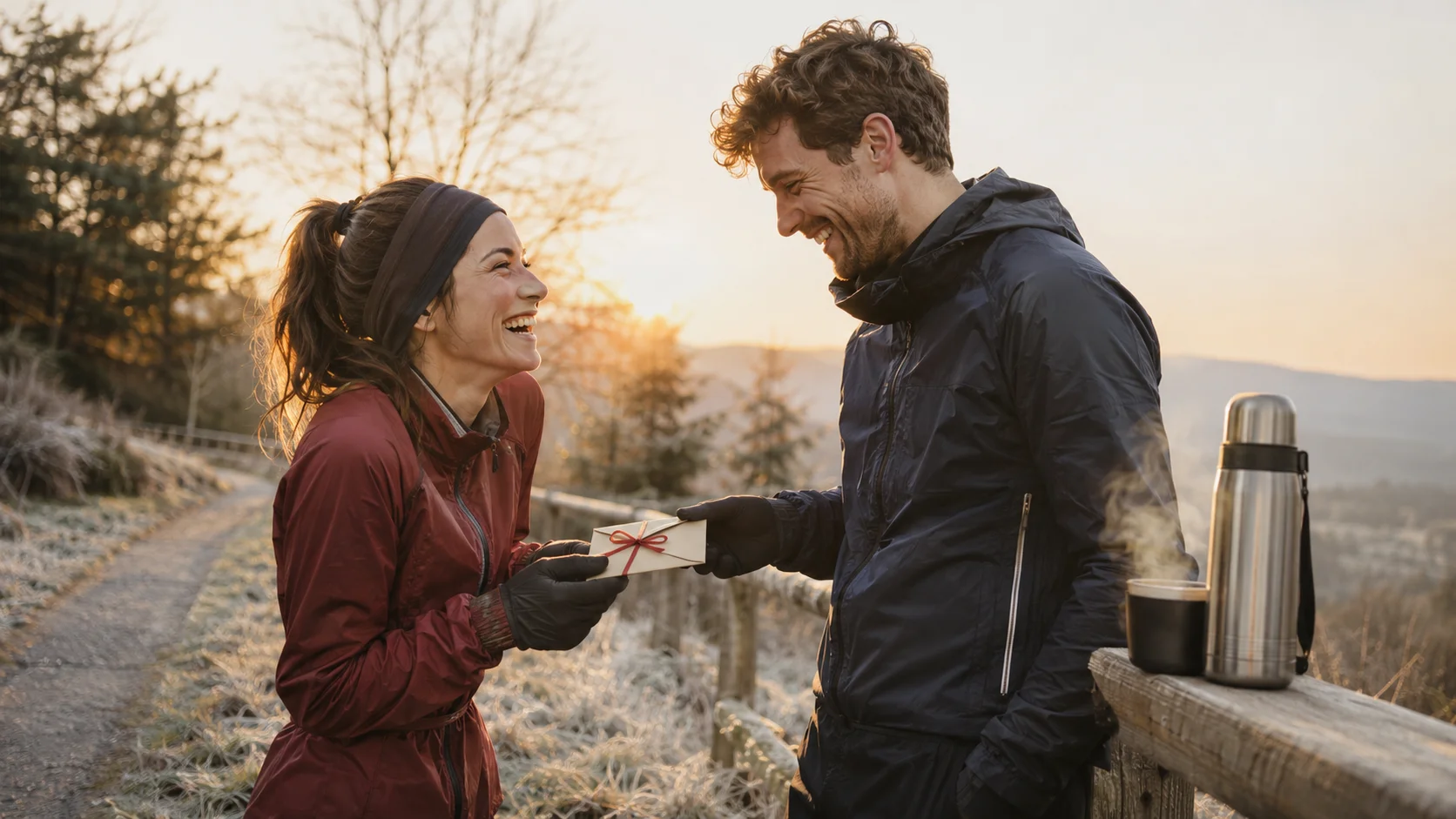
Some of the best options cost almost nothing beyond time, which is the resource a new relationship is actually testing. Planning a sunrise hike with a thermos of coffee waiting at the overlook, or cooking a post-workout dinner together, follows the same logic Athletic Dating laid out in its piece on why the kitchen date beats another reservation, which drew on the self-expansion research on couples who try new things together.
The opposite case is also worth naming, because gifts that comment on the recipient's body or training rarely land well early on. A scale, a nutrition program, a personal training package bought without being asked for, or a fitness tracker given to someone who has never mentioned wanting one can read as an assessment rather than a present, no matter how supportive the giver meant it to be.
Timing the exchange itself deserves some thought, since couples six weeks in often have not agreed on whether they are exchanging gifts at all. A low-key conversation in early December about what each person is planning for the holidays tends to prevent the lopsided moment when one partner arrives with a wrapped box and the other arrives with nothing, which is a mismatch no research study can fix after the fact.
Galak's advice in the Carnegie Mellon release pointed givers toward thinking about how valuable a gift might be "over the course of the recipient's ownership," and for an experiential gift that horizon includes the anticipation before the event and the memory after it. A spring half marathon entry bought in December, for instance, gives a new couple four months of training runs to look forward to, and the gift keeps working every Saturday morning the two of them lace up together on the way to the start line in April.