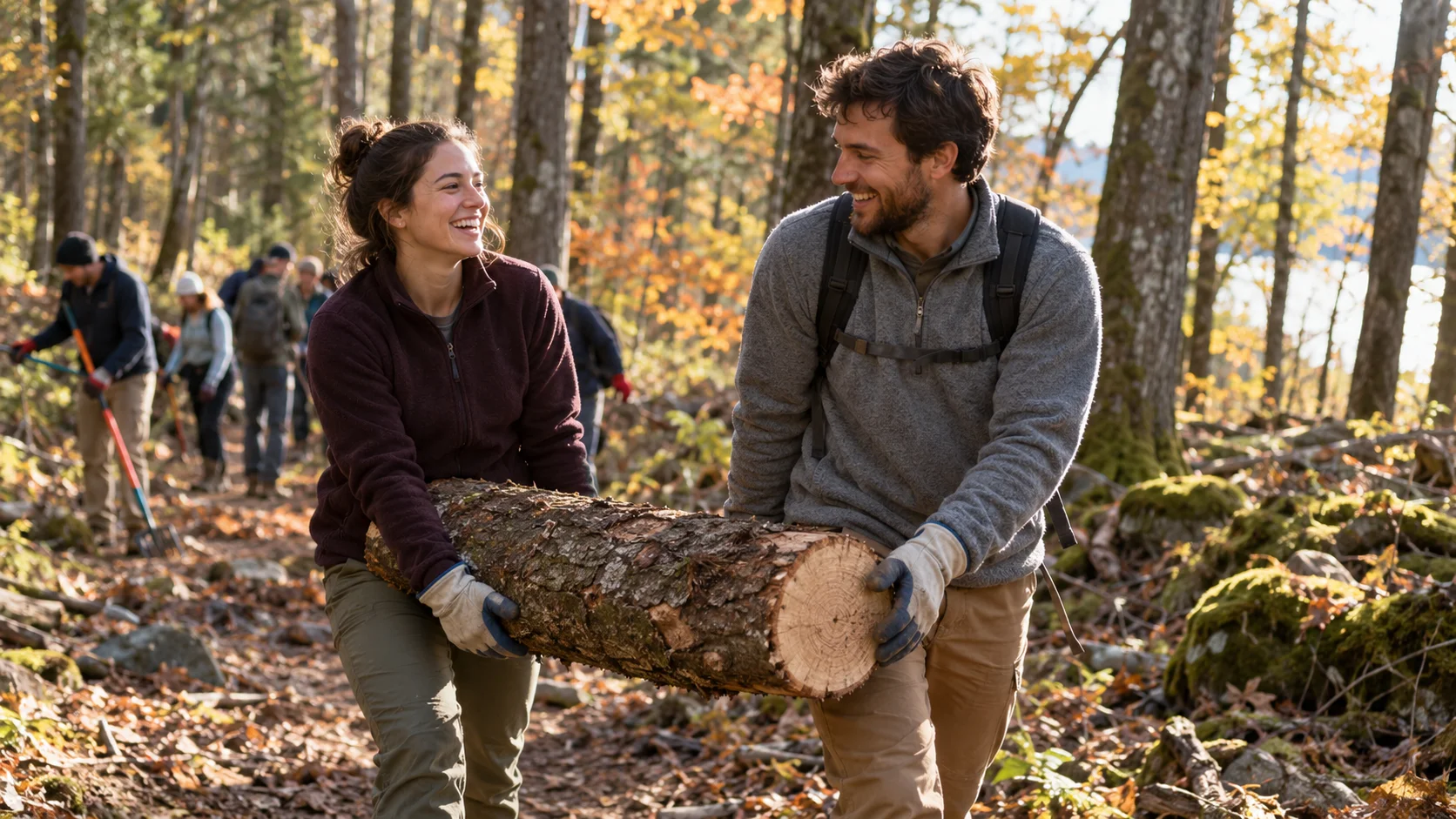
At a quarter past eight on a cold Saturday morning, the sign-in table at a trailhead looks less like a date than a chore list, with a cardboard box of work gloves, a clipboard and a crew leader explaining which way the blade of a pair of loppers should face. Two people who met three weeks ago stand near the back, sharing one thermos, about to spend four hours dragging cut brush off a fire road together.
That scene is the volunteer date, and it rests on a sturdier evidence base than most dinner reservations. Research connects visible generosity to how desirable people find one another, links new shared challenges to how close couples feel afterward, and rates outdoor service work as real exercise. For active singles and new couples who want to know who someone is when the task gets hard, a shift on a trail crew, a tree planting or a morning at the food bank is a better test than a cocktail menu.
The format also fits the calendar. The fourth Saturday of October has long carried the name Make A Difference Day, and local groups and campuses still organize service events around it, so the week ahead is full of one-day shifts looking for extra hands.
What the Research Says About Generosity and Attraction
In 2017 a team led by Steven Arnocky, a psychologist at Nipissing University in Ontario, published two linked studies in the British Journal of Psychology testing an old evolutionary idea, that kindness works partly as a signal to potential partners. According to the university, the researchers surveyed approximately 800 people, and those who scored higher on altruism reported being more desirable to the opposite sex and reported more partners, with the association stronger among men.
"We've provided the first empirical evidence that altruism may tangibly benefit mating in humans," Arnocky said in the university's announcement of the work, adding that "altruism evolved in our species, in part, because it serves as a signal."
A later study by Judd, Mills and Allen in Evolutionary Behavioral Sciences, drawing on 445 unmarried Australian adults, found that self-reported altruism was not associated with self-reported mating success, which is a fair warning against treating a soup kitchen as a pickup strategy.
What a volunteer shift offers that no survey can is direct observation. Over three hours you see whether a new partner takes correction from a 70-year-old crew leader with good grace, whether they grab the heavier end of a log without being asked, and whether they bother to learn the name of the teenager working the next station. Those small moments are the costly signals the Nipissing team was measuring, delivered in real time instead of on a questionnaire.
Why Doing Something New Together Brings Couples Closer
The second strand of research comes from the psychologist Arthur Aron, whose laboratory spent decades studying how couples grow through what he called self-expansion. In a set of experiments published in the Journal of Personality and Social Psychology in 2000, couples assigned to a seven-minute novel and arousing task reported larger gains in relationship quality than couples given a more mundane activity, even though the novel task lasted only a few minutes.
A volunteer shift is that experiment stretched across a morning. Most people have never split a stand of invasive honeysuckle, mixed mortar on a build site or sorted a pallet of canned goods by expiration date, so both partners start as beginners and learn the work side by side. We traced the same self-expansion logic through the cook-together date, and the volunteer version adds a stranger giving instructions, a deadline set by daylight and a visible result at the end.
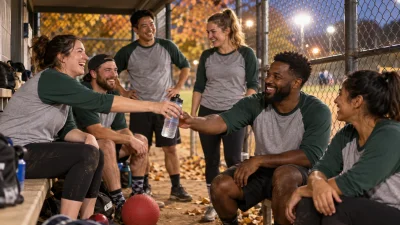
Proximity matters as well. Repeated, low-pressure time in the same place is the engine behind friendships and romances that start in coed rec leagues, and a standing monthly crew gives singles a similar setting where the same faces return every few weeks and conversation grows out of shared work rather than forced small talk.
The Workout Hidden Inside a Work Shift
Outdoor service work counts as exercise, and the numbers are not trivial. The 2024 Adult Compendium of Physical Activities, the reference researchers use to estimate energy cost, rates planting trees at 4.5 METs, raking at 4.0, moderate weeding at 4.5 and pushing a loaded wheelbarrow at 4.8 to 6.0, depending on effort. Clearing land and hauling brush at a vigorous pace rates 6.3 METs, while carrying or loading lumber at moderate effort sits at 5.5.
A MET multiplied by body weight in kilograms gives a rough count of calories burned per hour, so a 70 kilogram volunteer hauling brush for three hours burns somewhere near 1,300 calories, and the same person planting saplings burns close to 950. Digging at a standard pace, rated 5.0, adds the kind of hip-hinge and grip work that makes a deadlift session feel familiar, and it arrives with fresh air and a crew to talk to.
Anyone who trains will recognize the pattern. The work runs in intervals, with ten minutes of hard pulling followed by a few minutes of walking the cut material to a pile, and the pace is set by the task rather than a clock, which is why a four-hour shift can leave legs and forearms sore the next morning.
Millions of Americans Already Spend Their Weekends This Way
According to AmeriCorps and the Census Bureau, more than 75.7 million people, or 28.3 percent of Americans, formally volunteered through an organization in 2023, giving 4.99 billion hours of service valued at $167.2 billion. More than 54 percent of Americans helped neighbors informally over the same period.
"We are witnessing a remarkable resurgence in volunteering," AmeriCorps chief executive Michael D. Smith said when the figures were released.
There may be a longer payoff too. A 2013 meta-analysis by Morris Okun, Ellen Yeung and Stephanie Brown in Psychology and Aging found that among older adults, volunteering was associated with a 24 percent lower risk of death after adjusting for other factors. The design shows an association rather than proof of cause, but it places a regular service habit in the same conversation as a regular training habit.
Where Couples Can Sign Up Together
The easiest entry point is a local park conservancy, land trust or trail club, most of which post single Saturday shifts and provide tools and gloves. National Public Lands Day, which the National Environmental Education Foundation calls the nation's largest single-day volunteer event for public lands, fell on September 26 this year, and the foundation noted that some events would continue in the following weeks.
Habitat for Humanity lets volunteers search local build days by ZIP code, and many affiliates schedule Saturday crews that welcome first-timers. Food banks run sorting and packing shifts almost every weekend, which suit couples who want a lower-intensity first outing or a rainy-day backup plan.
For couples ready to turn a date into a trip, American Hiking Society runs weekend and week-long Volunteer Vacations in which crews of 6 to 20 volunteers work with a crew leader for six to eight hours each working day. The organization states that no prior trail maintenance experience is necessary, and it charges $425 for a first trip in a calendar year and $375 for each additional trip.
How to Turn a Shift Into a Date
Choose a shift of three to four hours, long enough to settle into the work but short enough that neither person feels trapped. When registering, ask the coordinator to place you on the same crew, because an organization trying to fill stations will otherwise split up two names that arrived separately.
Physical outdoor tasks work better than solo indoor ones, since hauling, digging and planting are done in pairs and leave room to talk. Dress the way you would for a hike in shoulder season, bring a refillable bottle and plan the meal afterward, which is where the real conversation tends to happen once the gloves come off.
On the drive home, the details are what stay: who offered the last granola bar to the crew leader, who kept going on the final pile when everyone else had stopped, and who already wants to know when the next workday is posted.