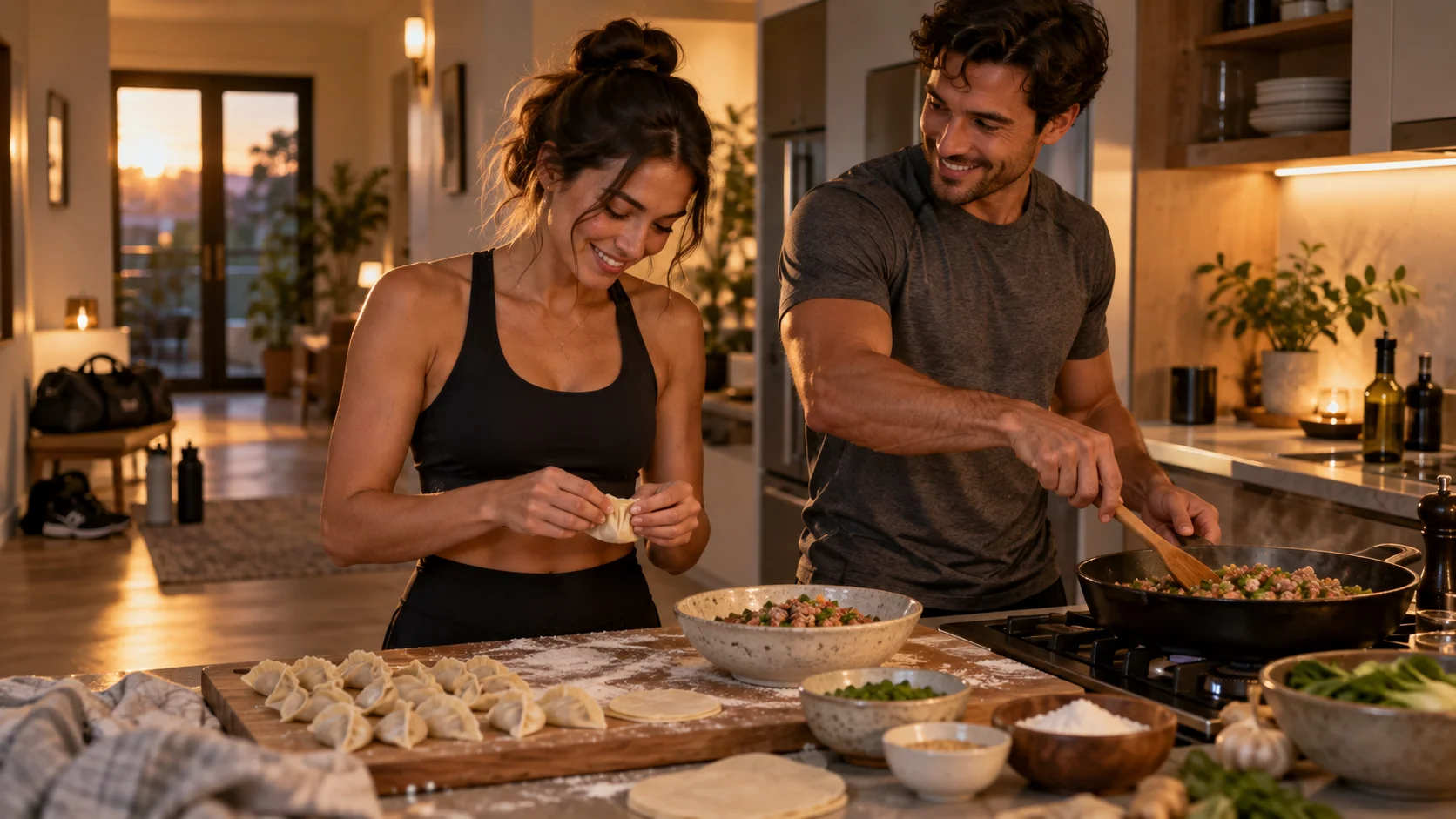
The workout ends, the playlist cuts out, and two people stand in a kitchen with a pound of ground turkey, a knob of ginger, and a recipe for Thai larb that neither of them has ever attempted. One reads the instructions aloud while the other toasts rice in a dry pan until it smells like popcorn. Somewhere between grinding that rice into powder and arguing over how much fish sauce counts as a splash, the evening has turned into a date. Nobody booked a table, and nobody checked the bill.
The cook-together date sits in an odd spot in modern dating. It shows up on nearly every list of wholesome date ideas, including our own guide to how the wellness date has replaced "let's grab drinks", yet it rarely gets taken seriously as a format with its own logic. The research behind it is more interesting than the list entries suggest, and it points toward a specific way of doing it.
Cooking a new dish together works because it stacks two things relationship science keeps finding: couples who share novel, slightly challenging activities report more satisfaction, and couples who share more meals report the same, though the second effect is modest and correlational. For active couples, the kitchen adds a third payoff, a recovery meal built to a real protein target instead of whatever the delivery app suggests.
What the Research on New Experiences Says
Arthur Aron, the Stony Brook University psychologist behind the self-expansion model of relationships, has spent decades testing a simple idea. People are drawn to partners who help them grow, and the early rush of a relationship comes partly from absorbing a new person's perspectives, skills, and identity into one's own. That rush fades as the newness wears off, which is the problem his work tries to solve.
In a review published in May 2026 in the journal Behavioral Sciences, Aron and Colgate University's Jennifer M. Tomlinson restate the core of that work. "But we argue that a major way to reinvigorate relationships is by doing novel and challenging (self-expanding) activities together with one's partner, so that the self-expansion becomes associated with the relationship," they write in the review's abstract.
The evidence they summarize goes back to a set of studies Aron and colleagues published in 2000. In a newspaper survey and a separate door-to-door survey, the correlation between relationship satisfaction and how exciting people rated the things they did with their partner landed at 0.45 and 0.51, which is strong for social science. The follow-up experiment was stranger. Couples were tied together at the wrist and ankle and asked to crawl across a mat as a team, while comparison couples completed a mundane task rolling a ball. The couples who completed the awkward, novel task together showed significantly greater relationship satisfaction afterward.
None of those studies involved a stove. The link to cooking is an application, and it rests on what a new recipe asks of two people: coordination, a little uncertainty, a skill neither of them owns yet, and a result they can taste. Aron and Tomlinson close their review with advice that reads almost like a recipe card for the format, noting that "people in romantic relationships (particularly long-term) can improve their lives by regularly doing new, novel, and interesting activities together with their partner."
What the Research on Shared Meals Adds
A second line of evidence arrived this year from Germany. Researchers Ira Elisa Herwig, Vanessa Knobl, and Jutta Mata at the University of Mannheim analyzed data from 12,686 adults between 18 and 49, plus 5,276 of their partners, drawn from a national family panel surveyed in the fall of 2023. Their paper, published in the journal Appetite under the title "Two forks, one meal," found that couples shared meals an average of 10.23 times a week.
The headline result was that more frequent shared meals predicted higher relationship satisfaction, with a standardized coefficient of 0.14. That is a small association, measured with a single 0 to 10 satisfaction question, and the authors are blunt about its limits. "Third, as with all observational studies, no causal conclusions can be drawn," they write. Happier couples may simply eat together more often, and the arrow could point either way.
The same paper turned up a detail that matters for anyone thinking about food and fitness as a pair. Shared meals were associated with higher meat consumption among women but not among men, and showed no significant association with body mass index. Citing earlier work, the authors also note that couples shared about 71 percent of their dinners after marrying and moving in together, compared with roughly 25 percent before. Dating couples who live apart are the ones with the most room to add a shared meal, and the most reason to make it count.
The Evidence on Cooking Itself
Research on cooking as an activity, separate from eating, is thinner. A 2018 systematic review in Health Education and Behavior screened 377 articles and found 11 that met its criteria. Cooking programs "yielded positive influences on socialization, self-esteem, quality of life, and affect," the authors reported, while rating the overall evidence as weak. "This review suggests that cooking interventions may positively influence psychosocial outcomes, although this evidence is preliminary and limited," wrote lead author Nicole Farmer and her colleagues. Those studies looked at community and clinical programs, not couples, so they support the idea that cooking feels good without telling us much about romance.
Taken together, the case for the kitchen date is a reasonable inference from solid pieces, not a single study proving it. Novelty shared with a partner has the strongest backing. Regular shared meals carry a small, consistent association. Cooking as an activity seems to lift mood. The format combines all three in one evening.
Building the Post-Workout Version
For people who train, the cooking date solves a practical problem. A run, a lifting session, or a climbing night leaves both people hungry, and the default answer is a restaurant meal ordered on an empty stomach or takeout eaten in front of a screen. Cooking turns that hunger into the activity.
The International Society of Sports Nutrition's position stand on protein and exercise, published in 2017 by Ralf Jäger and colleagues with Jose Antonio as senior author, gives the target. Most people who exercise do well with 1.4 to 2.0 grams of protein per kilogram of body weight per day, split into servings of about 20 to 40 grams, or roughly 0.25 grams per kilogram, spread evenly every three to four hours. The ISSN position stand also notes that the anabolic effect of exercise lasts at least 24 hours, which takes the panic out of the so-called anabolic window. A meal you start cooking 45 minutes after you get home still counts.
That window gives the date its shape. Shower, split the prep, and eat within a couple of hours of finishing the workout. A 150-pound person, about 68 kilograms, lands near 17 grams at the 0.25 per kilogram mark, while a 200-pound partner, about 91 kilograms, sits closer to 23. Building the plate around 25 to 35 grams each covers most couples with room to spare. Our list of athletic date ideas that won't be awkward makes the same point from the other direction, advising a plan for food and water once the activity ends.
Choose the Recipe for Novelty, Not Comfort
The self-expansion research suggests one rule above the rest: pick something neither of you has made. A dish one partner cooks every Sunday turns the other into an audience, while a recipe that is new to both puts you on equal footing. Fresh pasta, a curry built from whole spices, dumplings folded by hand, a whole roasted fish, or that Thai larb all ask for a technique with a learning curve short enough to finish before anyone gets cranky.
Couples with different diets can use the gap as part of the challenge. If one of you eats plant-based, cooking a high-protein vegan dish from scratch becomes the novel task for both. There is plenty of company for that choice, as our sister site HitsCulture found in its look at the hip-hop guide to a vegan lifestyle. Tofu pressed and seared, lentils, tempeh, and edamame can hit the same protein range with some planning.
Split the Work So Both People Own the Result
The crawling experiment worked because neither partner could finish it alone. Divide the recipe so the same is true in the kitchen, with one person on the protein and the other on the sauce, then trade for the next dish. Reading the steps aloud, tasting as you go, and adjusting together turns cooking into a conversation that runs on its own momentum, which is a gift for anyone who finds sit-down dinners stiff.
Then eat at a table. The Mannheim study measured shared meals, not shared cooking, and a meal eaten facing each other is the piece of the evening that maps most directly onto its findings. Phones down, plates up, and a quick verdict on whether the recipe earns a second round.
Make It a Rotation, Not a One-Off
Novelty is a renewable resource only when you keep renewing it. A cooking class every month or two adds instruction and guarantees the new-skill element, while cooking at home in between keeps the habit cheap enough to repeat. Some couples work through one cuisine for a season, then switch, which gives each date a reason to exist and a running list of wins.
The research does not promise that a skillet will save a struggling relationship, and the Mannheim authors would be the first to say their data cannot show it. What it does describe is a pattern worth building on purpose: new challenges taken on together, regular meals shared across a table, and a body that gets fed properly after the work it just did. On a Saturday after a long run, that pattern fits on a single cutting board.