Daylight saving time ended Sunday, November 1, shifting the clock back one hour across most of the United States. For people who built their social lives around sunset runs, evening bike rides and post-dinner walks, the change is more than a timekeeping adjustment: it removes usable daylight from the end of the workday. In New York, sunset moved from 5:53 p.m. before the change to 4:52 p.m. afterward. By December 7, sunset will arrive at about 4:28 p.m., while many people are still answering email or commuting home.
That shift can turn an easy second-date plan into a logistical problem. A 6:30 p.m. jog along the river now takes place in darkness, often on streets where drivers are tired and visibility is reduced. Without a backup plan, an active date can quietly become drinks or dinner indoors—not necessarily because either person prefers it, but because the original activity no longer fits the season.
The practical response is to make a few deliberate adjustments: schedule the main activity during daylight, select venues that are lit and staffed after dark, and wear clothing or equipment that helps drivers see you. These changes allow singles and couples to preserve an active social routine without treating winter as a four-month interruption.
What Shorter Days Do to an Active Social Life
Research generally shows that physical activity declines during shorter, colder and wetter days, although the average change is usually modest rather than dramatic. In a 2017 PLOS ONE study, researchers fitted 4,051 older adults in Norfolk, England, with activity monitors for one week. Shorter days combined with poor weather were associated with as much as a 10 percent reduction in average physical activity. Participants recorded about eight fewer minutes of light-to-vigorous movement and 15 more sedentary minutes each day than they did under the most favorable conditions.
Other studies point in the same seasonal direction. A Loughborough University pedometer study of 96 British adults recorded an average of 10,417 steps per day in summer, compared with 9,132 in winter—a difference of roughly 1,285 steps. An analysis of 96,600 UK Biobank participants who wore wrist-based activity monitors also found lower activity during winter, although the authors described the effect as small.
A reduction of about 1,000 steps is not a health crisis, but it can accumulate when repeated across several months. It is also important to distinguish ordinary seasonal sluggishness from seasonal affective disorder. The National Institute of Mental Health describes seasonal affective disorder as a form of depression linked to changes in daylight that commonly begins in late fall or early winter. Persistent low mood, loss of interest or difficulty managing daily responsibilities warrants a conversation with a qualified clinician. A reflective vest, exercise plan or sunrise walk is not a substitute for professional care.
The broader lesson is that winter can disrupt routines before people consciously decide to become less active. The evening that once held a run club, pickup game and walk home may now offer a dark sidewalk and a warm couch. Unless the activity is moved to another time or place, the plan disappears from the calendar.
Move the Date Into Daylight
For most people, consistency matters more than the exact hour of exercise. A 2023 review in Sports Medicine Open examined 26 studies on training time and found no clear evidence that one particular time of day universally produces better results. The review did find larger benefits when people trained at the same time they were later tested, suggesting that performance can adapt to a regular schedule. In practical terms, a Saturday morning run can build the same basic fitness as a Tuesday evening run if both happen consistently.
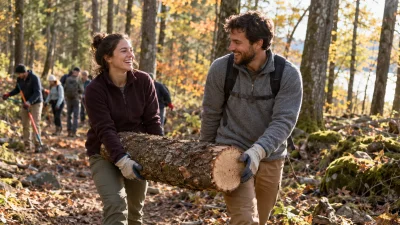
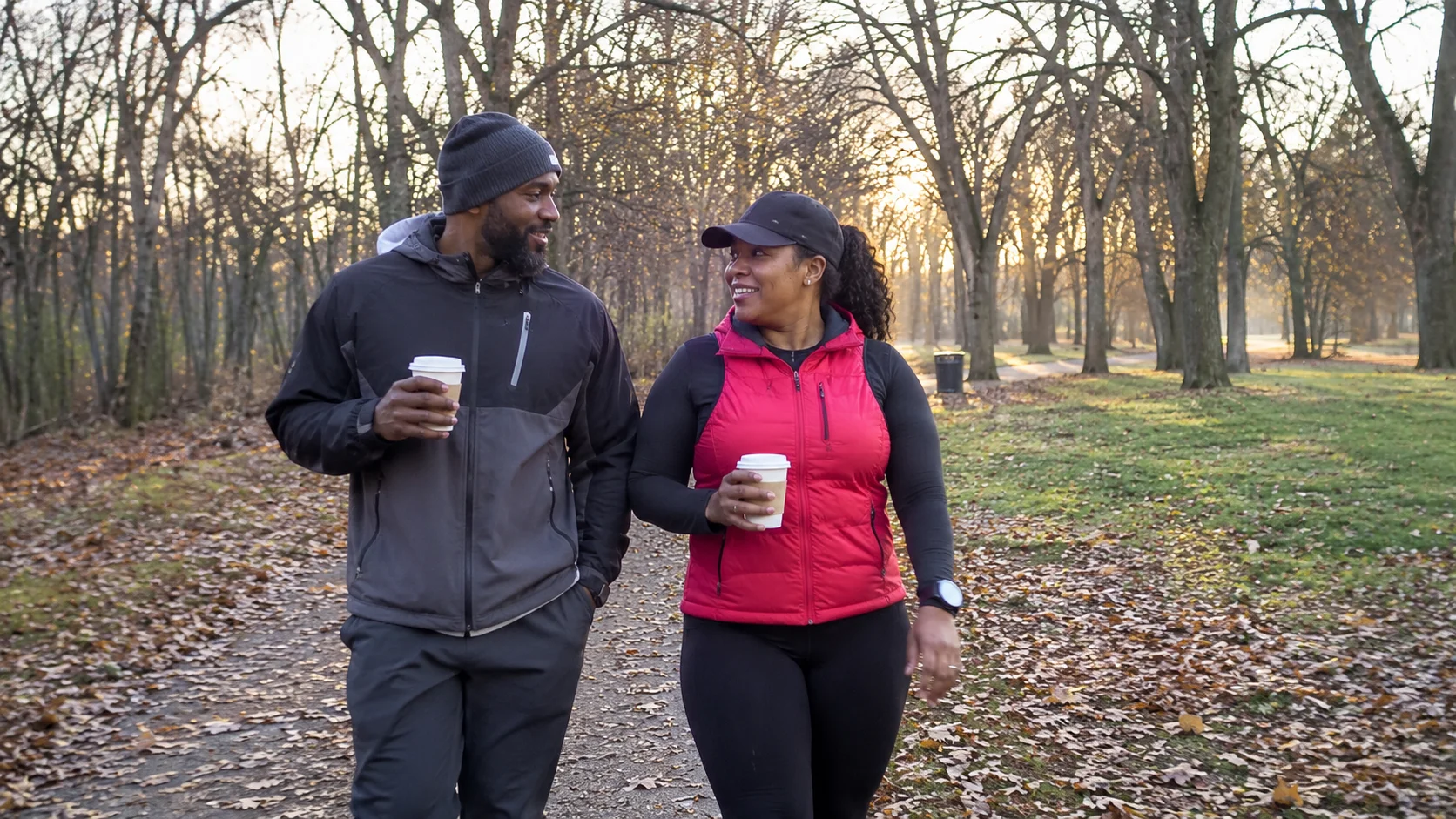
That flexibility makes daylight the simplest tool for protecting an active dating routine. Consider a trail walk followed by coffee, a lunch-hour loop for two people who work nearby, or a morning yoga class followed by breakfast. These options preserve movement while leaving the darker evening for a slower, seated conversation.
When two people have different work schedules or sleep preferences, they can start by identifying the overlap rather than asking one person to repeatedly compromise. The guide to sleep schedules and chronotype compatibility for couples who train offers strategies for finding a workable routine when one person prefers early mornings and the other is more comfortable exercising at night.
Daylight may also offer benefits beyond visibility and temperature. A 2023 study of 86,772 UK Biobank adults, published in Nature Mental Health, associated greater daytime light exposure with a lower risk of major depressive disorder, independent of nighttime light exposure. Monash University, which announced the research, reported a 20 percent lower depression risk among participants with high daytime light exposure. The study was observational, the sample was older on average than the general population, and the findings do not prove that daylight alone prevents depression. Still, they support a practical habit: seek bright outdoor light during the day and keep nighttime environments darker.
“It's about getting bright light in the day and darkness at night.”
Study coauthor Associate Professor Sean Cain also noted that people now spend about 90 percent of the day indoors under electric lighting. A weekend hike, outdoor market walk or daylight park date can therefore serve two purposes: it creates time for connection and adds outdoor light that may be missing during the workweek.
Make the Invitation Specific
Seasonal dating plans work better when the invitation reflects the actual conditions. In late fall, “Would you like to go for a quick run after work?” may mean running in darkness. Instead, name the time, route and lighting conditions, and offer a daylight option first.
- Suggest a weekend morning or lunch-hour activity when possible.
- State whether the route is paved, lit, staffed or isolated.
- Treat a weekday evening invitation as an indoor plan unless the other person has said they are comfortable training outside at night.
- Build in a warm, public follow-up such as coffee, tea or a meal.
After Dark, Choose Lit and Occupied Venues
Evening remains the most convenient meeting time for many working adults, so the goal is not to eliminate active dates after sunset. It is to move them into settings that provide lighting, predictable surfaces and other people nearby. Indoor ice rinks, lap pools, dance classes, recreation-center courts, climbing gyms and illuminated public tracks can all combine movement with a greater sense of security.
That matters especially during a first or second meeting. A venue with staff, regular activity and clear exits reduces the need to navigate an unfamiliar, unlit route while also trying to get to know someone. For outdoor plans, choose streets with sidewalks, crossings and steady pedestrian traffic rather than assuming that a familiar daytime route remains suitable at night.
Federal crash data underscores the visibility problem. The National Highway Traffic Safety Administration's 2023 pedestrian fact sheet recorded 7,314 pedestrian deaths in traffic crashes. Seventy-seven percent occurred in darkness, compared with 19 percent in daylight. The largest share—26 percent—occurred between 6 and 8:59 p.m., the same window when many people leave work, meet for dinner or begin an evening walk.
NHTSA advises pedestrians to take extra care at night and in bad weather. Where sidewalks are unavailable, it recommends walking facing traffic and staying as far from vehicles as possible. For two people walking together on a narrow shoulder, that may mean moving single file rather than side by side. The conversation can resume once the route reaches a safer, better-lit area.
Make Yourself Visible to Drivers
Dark clothing can make pedestrians and cyclists difficult for drivers to detect, even when the person wearing it feels visible. Research from Professor Joanne Wood's Vision and Driving group at Queensland University of Technology has focused on how drivers recognize human movement at night. The group's work on “biomotion” found that reflective strips placed on moving joints helped drivers identify pedestrians and cyclists from substantially farther away than a vest containing the same amount of reflective material.
For cyclists, reflective markings on the ankles and knees increased visibility distances as much as sixfold compared with riders without retroreflective markings. The research also found that people tended to overestimate the value of fluorescent clothing without reflective material after dark. Fluorescent colors can stand out in daylight, but they do not provide the same benefit when headlights are the primary light source.
“Reflective material on the moveable joints (wrists, ankles, knees and elbows) can strongly enhance night-time conspicuity,” Wood said in a university release about research involving cyclists and runners in Brisbane and Leeds.
For an evening run or ride, a practical minimum is a reflective ankle band for each person, a headlamp or chest light for the lead runner, and shoes, tights or outerwear with reflective panels near the heel, knee or wrist. Cyclists should also use front and rear lights where required and should check local regulations before riding at night.
These items are inexpensive compared with the cost of a dinner out, and they are easy to store in a gym bag. The goal is not to create specialized winter gear for every date; it is to make movement visible early enough for a driver to recognize two people as people, rather than as indistinct shapes at the edge of the road.
Why Keep Movement in the Relationship?
Allowing active dates to disappear until spring may be convenient, but it can also remove a useful source of shared time. Brigham Young University researchers studied nearly 1,700 young married couples in research discussed in our coverage of how often couples exercise together. About 60 percent of husbands and wives exercised, but only roughly one-third exercised together. Shared activity was associated with better communication.
“People reported more positive outcomes in communication and conflict resolution when they exercised together,” said Professor Jeremy Yorgason, the study's lead author.
The research was associational, and married couples are not the same as people on a third date. It does not show that exercising together guarantees a stronger relationship. But a shared walk, class or run can give two people a low-pressure way to spend time together and talk without relying entirely on face-to-face conversation.
The most reliable winter strategy is therefore simple: put the active plan on the calendar before the week fills up. Choose Saturday at 9 a.m. instead of Thursday at 7 p.m. when daylight and work schedules make that the safer option. If you go out after dark, select a populated, illuminated venue and carry reflective gear. Daylight saving time has already ended, but an active social life does not have to end with it. Even as sunset reaches its earliest point in early December, planning can keep movement—and connection—on the schedule.