The number worth stopping on is not about happiness. It is mathematical. In a nationally representative sample of 1,693 young married couples, roughly six in ten husbands and six in ten wives said they exercise. Only about a third of those couples exercise together.
Which means most of these people are already moving. They own the shoes. They have found the hour somewhere. They just spend it apart, on separate schedules, in separate rooms, with separate playlists, and then meet again in the kitchen at nine at night with nothing left to say to each other.
The research comes from the School of Family Life at Brigham Young University, published this year in the journal Family Relations, drawing on couples from the CREATE study. Its central claim is modest in a way that makes it more useful than the headlines it produced. Exercise of any kind tracked with better communication, better conflict resolution, and less conflict, for husbands and for wives. Couples who exercise together scored somewhat better than couples who trained solo. The researchers are careful about that gap, so we will be too: it was not statistically significant. It could be chance.
The finding that survives the caveat
Strip out the part that might be noise and something sturdier is left. Across the three outcomes the team measured, the effect of exercise was largest on communication. Not on how often couples fought. Not on some general glow of satisfaction. On talking.
Jeremy Yorgason, one of the study's authors, put the shared-exercise piece plainly.
"People reported more positive outcomes in communication and conflict resolution when they exercised together."
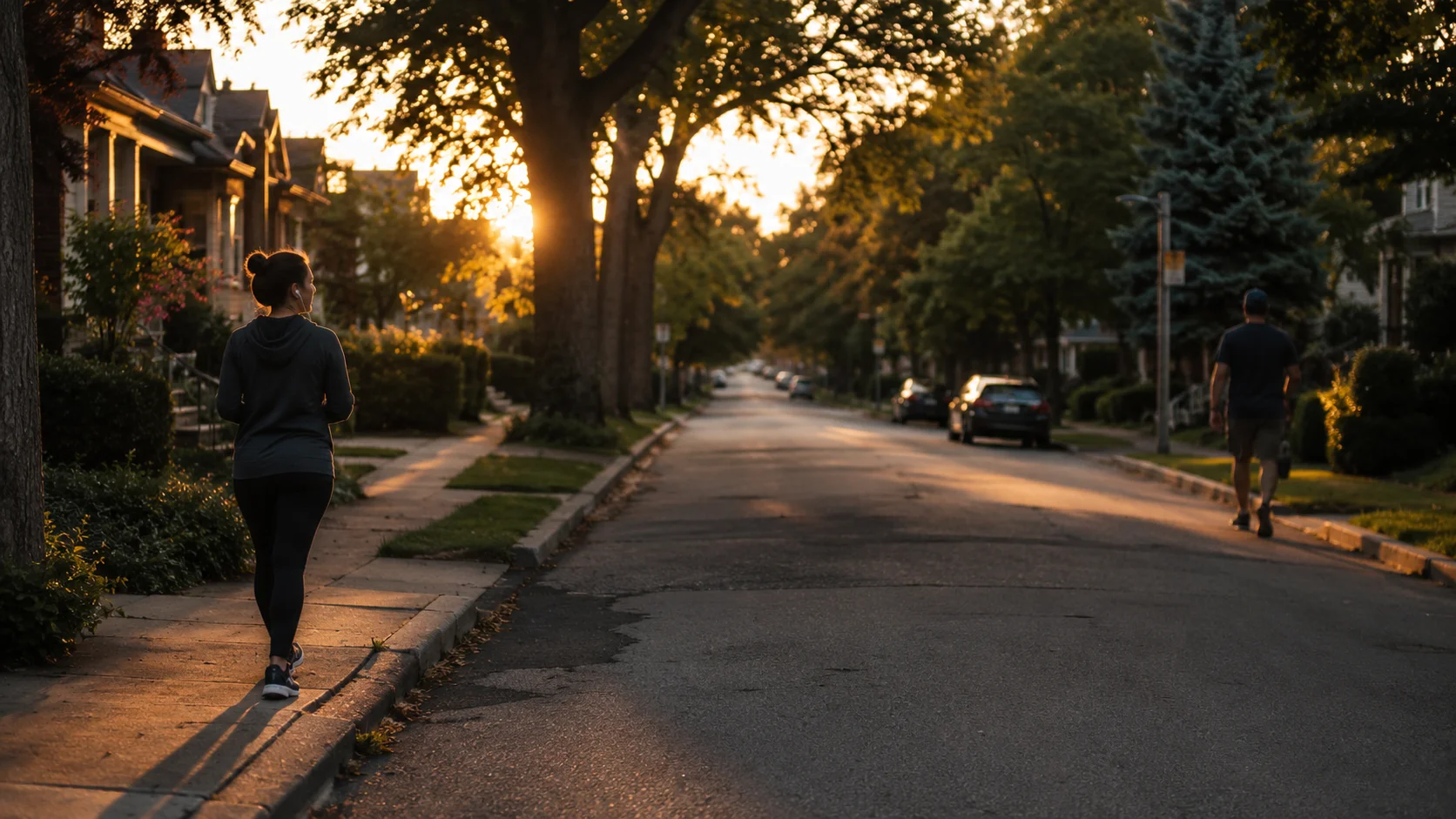
And the most reported shared activity in the whole sample was not a bootcamp, not a lifting split, not a race. It was walking. The cheapest, least impressive, most available thing two people can do with forty minutes.
There is an obvious mechanical reason, and the researchers point at it themselves. You can talk while you walk. You cannot talk through a max effort interval. Walking as a couples workout is the only modality on the list where the workout is not competing with the conversation for oxygen. Which reframes what the study is measuring. This may be less about exercise and marriage communication in a physiological sense and more about the fact that a walk is a protected forty minutes with no screen in it, no third party, and a socially acceptable reason to be side by side rather than across a table.
Why the together gap is so wide
Sixty percent move. Thirty-three percent move together. That gap is not a motivation problem, because the motivation is already spent. It is a logistics problem, and often a pace problem.
Anyone who has tried to merge two training habits knows the failure mode. One person runs a nine-minute mile and one runs a thirteen. One likes 6 a.m. and one is useless before ten. One wants the class, one wants the quiet. So both quietly decide it is easier to go alone, and the decision never gets discussed, it just calcifies. We have written before about how mismatched fitness levels play out in a relationship, and the BYU numbers suggest the cost of that quiet split is higher than anybody scores it at the time.
The walking finding is the way out of that trap, and it is almost annoyingly simple. A walk absorbs a pace mismatch. A walk does not require anyone to be good at it. Nobody has ever finished a walk with their partner and felt outclassed. If the goal is building connection through movement, the correct starting activity is the one with the lowest performance stakes, not the highest.
The part about kids
One more finding in the paper deserves its own sentence, because it explains a lot of Tuesday nights. Couples with children scored worse on communication and on conflict resolution than couples without.
That is not a moral judgment on parenting. It is a description of what happens to an adult conversation when it is conducted in twelve-second increments between interruptions. It also means that the couples with the least available time are the ones who would benefit most from a shared workout routine that costs almost nothing to arrange. A stroller does not disqualify a walk. That is roughly the point.
What this means if you are still dating
Most of the coverage of this study filed it under marriage. That is too narrow. The mechanism it describes, that movement makes people talk better and that the talking is the payload, is exactly the thing the dating world spent 2026 rediscovering the expensive way.
Strava's most recent Year in Sport report, built on responses from more than 30,000 people, found that 46 percent would say an enthusiastic yes to a workout as a first date, against 31 percent who called it a hard pass. Running clubs on the platform grew roughly three and a half times. Strava chief executive Michael Martin later told Fortune that one in five respondents had gone on a date with someone they met through a running club, and framed the shift this way:
"Gen Z is looking for real experiences, not more time staring at screens."
Meanwhile the Institute for Family Studies surveyed 5,275 unmarried adults between 22 and 35 and found only about 30 percent currently dating and only about 21 percent satisfied with their options. Put those two numbers next to each other and the picture is a generation that wants in-person connection, has correctly identified movement as the on-ramp, and is still mostly not doing it. The same gap as the married couples, one life stage earlier.
Which is why active dating habits are worth treating as a skill rather than a vibe. The low-pressure version already has a following. We made the case a while back for the walk as the least awkward first date available, and the BYU data is the grown-up sequel to it: the thing that helps you meet someone is the same thing that helps you stay talking to them nine years later.
How to actually do this
The research does not prescribe a protocol, so treat what follows as our reading of it rather than a finding.
Start with frequency, not intensity. The couples in this sample were not doing anything exotic. If training with your partner currently happens zero times a week, two walks is a large change and a gym membership is a fantasy.
Protect the format. The value seems to sit in the conversation the activity permits, so anything that kills conversation kills the mechanism. Headphones in, phones out, no podcast. If one of you is taking a call, this is a commute, not a practice.
Do not schedule it after a fight. The study links exercise to better conflict resolution skills over time, which is not the same as claiming a walk will resolve tonight's argument. Build the habit when nothing is wrong, so it exists when something is.
Respect August. If you live somewhere the heat index is doing damage this month, the walk moves to seven in the morning or eight at night, and you bring water, because a heat-stressed walk is not a calm one. Our sister site has a useful breakdown of how heat metrics actually work for outdoor training.
And if the two of you have wildly different fitness levels, borrow from the slow-training world rather than the performance one. The recovery-first case for walking our friends at Kits and Co. laid out earlier this summer applies cleanly here, because a session neither person has to recover from is a session you can do again tomorrow.
The honest bottom line
This study does not prove that working out together will save a marriage. It proves something smaller and more usable: among couples who already exercise, most do it alone, exercise of any kind is associated with talking to each other better, and the activity that showed up most often when couples did train together was the one requiring no equipment, no skill, and no shower.
A third of couples have found that. Six in ten are already halfway there and have not made the last move. Among relationship health habits with a plausible evidence base, this one has the lowest possible barrier to entry, which makes not doing it a strange thing to keep choosing.