
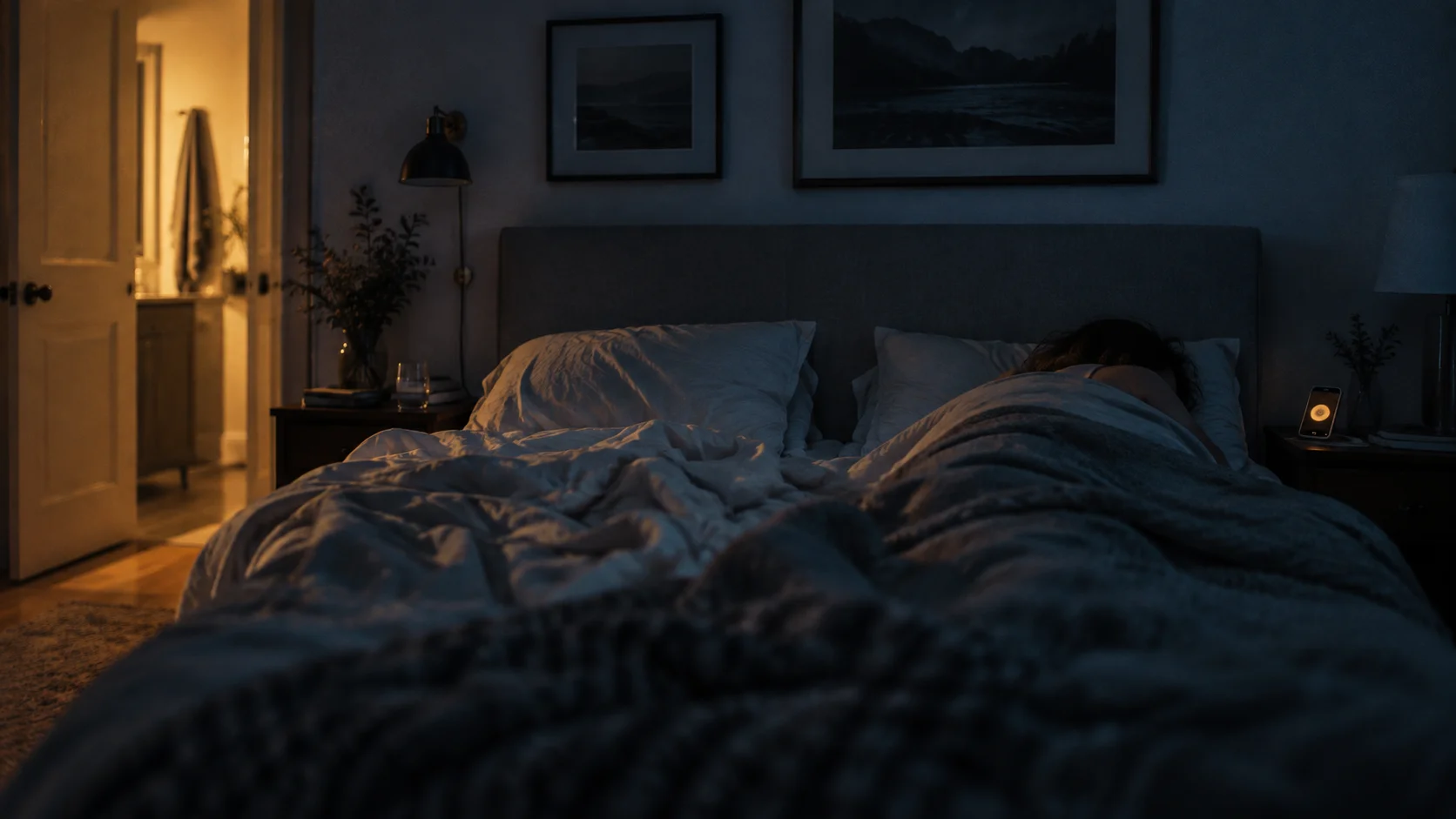
Somewhere tonight a runner will finish ten miles at half past nine, eat dinner standing at the counter, and get into bed beside someone who fell asleep before ten. In the morning that same someone will dress in the dark for a squat session that starts before six, and neither of them will call this a problem, because neither of them has ever seen it written down as one. When the American Academy of Sleep Medicine surveyed 2,007 American adults in June 2025, 37 percent said they go to sleep at a different time than they want to in order to accommodate a bed partner.
Another 31 percent told the same AASM survey that they sleep in a separate bed or space, and among adults between 35 and 44 that figure reached 39 percent. The poll carried a margin of error of two percentage points.
The useful finding sits somewhere less obvious than the headline. Couples who share a bed spend roughly three quarters of the night awake or asleep at the same time, and the size of that overlap tracks how satisfied they are with each other rather than whether one of them happens to be a morning person. Sleep and schedule compatibility behaves less like a fixed trait you screen for and more like a schedule two people build, which means it is one of the few compatibility questions you can actually do something about.
What Happens When Two Clocks Share One Bed
Heather Gunn and colleagues at the University of Pittsburgh strapped wrist actigraphs on 46 couples for ten days and compared their sleep minute by minute, which is a harder test than asking people how well they sleep together. Concordance, the share of the night both partners spent in the same state, ranged from 53 percent to 88 percent across the sample and sat around 75 percent for bed-sharing couples. Wives who reported high marital satisfaction showed higher concordance regardless of their husbands' attachment style.
The result that matters for anyone worried about dating outside their own clock came in the null finding. In that 2015 study published in SLEEP, concordance was not associated with the couples' sleep quality or with their circadian preference at all.
The sleep of married couples is more in sync on a minute-by-minute basis than the sleep of random individuals. This suggests that our sleep patterns are regulated not only by when we sleep, but also by with whom we sleep.
That is Gunn, describing the finding when the research was published. Her sample was small and married, and nobody should read 46 couples as the last word, but the direction of the evidence points away from the biological determinism that gets attached to lark and owl labels in dating copy.
A separate group went looking for evidence that people pair off with partners who share their clock, and did not find it. Studying 91 heterosexual couples in Poland, Patrycja Jocz and colleagues reported that similarity in chronotype between partners was not apparent at all, with a correlation of 0.09 that failed to reach significance. What did predict trouble was narrower and more specific: the gap between partners in their preferred time of day for sex was a negative predictor of satisfaction for both men and women, at correlations of 0.40 and 0.32 respectively in their 2018 paper in Frontiers in Psychology.
The Argument You Have the Next Day
Amie Gordon and Serena Chen ran two studies on what a bad night does to a relationship the following day. In the first, 78 people in relationships filled out 908 daily diaries across two weeks, and poor sleep predicted more frequent and more severe conflict the next day, an effect that held after controlling for stress, anxiety and depression. In the second, 69 couples came into a lab and were recorded working through a real disagreement, where a poor night predicted worse conflict resolution and lower empathic accuracy for both partners.
Even among relatively good sleepers, a poor night of sleep was associated with more conflict with their romantic partner the next day.
Chen, a professor of psychology at UC Berkeley, made that point when the research was published in Social Psychological and Personality Science. Gordon, then a doctoral student and the study's lead author, framed the practical version: couples who fight more are less happy and less healthy, and one input into that fighting is something as unromantic as a partner coming to bed at midnight three times a week.
The Session That Pays for It
For people who train, the schedule question has a second bill attached, and it arrives at a predictable time of day. A 2022 meta-analysis in Sports Medicine pooled 69 publications, 227 outcome measures and 959 participants to estimate what acute sleep loss does to physical performance, and found a mean decline of 7.56 percent, with roughly 0.4 percent lost for every additional hour awake before exercise. The heterogeneity was high and the sample was 89 percent male, so the precise figure deserves caution.
Negative effects on tasks performed in the afternoon and evening were consistent, while tasks performed in the morning were largely unaffected, which means a partner-driven late bedtime charges most of its cost to the evening session rather than the early one. Reviewing the same paper, Greg Nuckols noted at Stronger by Science that strength performance fell 2.85 percent on average while strength endurance fell 9.85 percent.
Injury risk is the harder currency: A 2019 review in Sports Medicine covering athletes between 14 and 25 reported that those getting under eight hours a night carried a higher risk of musculoskeletal injury, and noted that afternoon and evening training sessions themselves reduce total sleep by cutting into available time in bed. That finding belongs to young athletes rather than to every adult with a gym membership, but the mechanism is not age-specific: a nine o'clock session ends late, and the hours have to come from somewhere.
Couples who train together already know part of this story from the inside. Six in ten couples exercise, and only about a third do it together, a gap we covered in our reporting on what shared training does to communication, and the same scheduling friction that keeps two people in separate gyms keeps them in separate hours.
How Much of the Clock Will Actually Move
Genetics sets a floor here, and it is lower than the folklore suggests. A genome-wide analysis of 697,828 people identified 351 loci associated with chronotype and put the heritability at 13.7 percent, toward the lower end of previously reported estimates of 12 to 21 percent. The 5 percent of people carrying the most morningness alleles had their sleep timing shifted earlier by an average of 25.1 minutes compared with the 5 percent carrying the fewest, according to the 2019 paper in Nature Communications. Twenty-five minutes is a real difference and it is not a life sentence.
Behavior moves the clock considerably further: Elise Facer-Childs and colleagues took 22 healthy adults with late sleep patterns through a three-week protocol built out of unglamorous parts: wake two to three hours earlier with maximized outdoor morning light, sleep earlier with evening light restricted, fix meal times with dinner before seven, cut caffeine after three in the afternoon and naps after four. Sleep onset advanced by 1.73 hours and wake time by 1.92 hours.
The performance data from that study reads like an argument written for this audience. Grip strength improved significantly at eight in the morning and again at two in the afternoon, reaction time got faster at eight, and self-reported depression and stress scores both fell over the three weeks, as reported in the University of Birmingham research. It was 22 people with no long-term follow-up, and nobody has shown the shift holds for a year.
The Conversation Worth Having in Month One
Dating culture has a well-developed vocabulary for arguing about texting cadence and almost none for arguing about bedtime, which is strange given that one of those things predicts next-day conflict in a controlled study. The practical version of chronotype compatibility is not a screening question about whether someone is an owl. It is a scheduling conversation about which nights the two of you land in bed within an hour of each other, which sessions get moved to protect that, and whether the person doing the moving is always the same person.
Wendy Troxel, a senior behavioral and social scientist at RAND, has spent years arguing that the phrase sleep divorce does damage by framing separate rest as relational failure. Her proposed replacement is a sleep alliance, which she describes as a collaborative and couples-centered approach to sleep rather than a separation or a societally proscribed norm, one where couples work together so both partners get the rest they need.
Seema Khosla, a pulmonologist and AASM spokesperson, put the mechanism in plainer terms when the 2025 survey came out. Poor sleep leads to diminished empathy, patience and understanding, she said, and resentment grows when sleep is compromised by a disruptive partner, which makes a deliberate conversation about separate sleep spaces more productive than quietly enduring the arrangement for appearances. Her caveat matters as much as her advice: be intentional about spending time together before retiring to separate spaces.
None of this requires anyone to abandon the five o'clock session or the nine o'clock run. It requires knowing which of them is negotiable, and saying so before the sixth month, when the negotiation happens anyway and nobody has agreed on the terms. Partners who sort out the schedule early are doing the same work as the Hyrox doubles teams who learn to run at one pace, only with better long-term returns.