
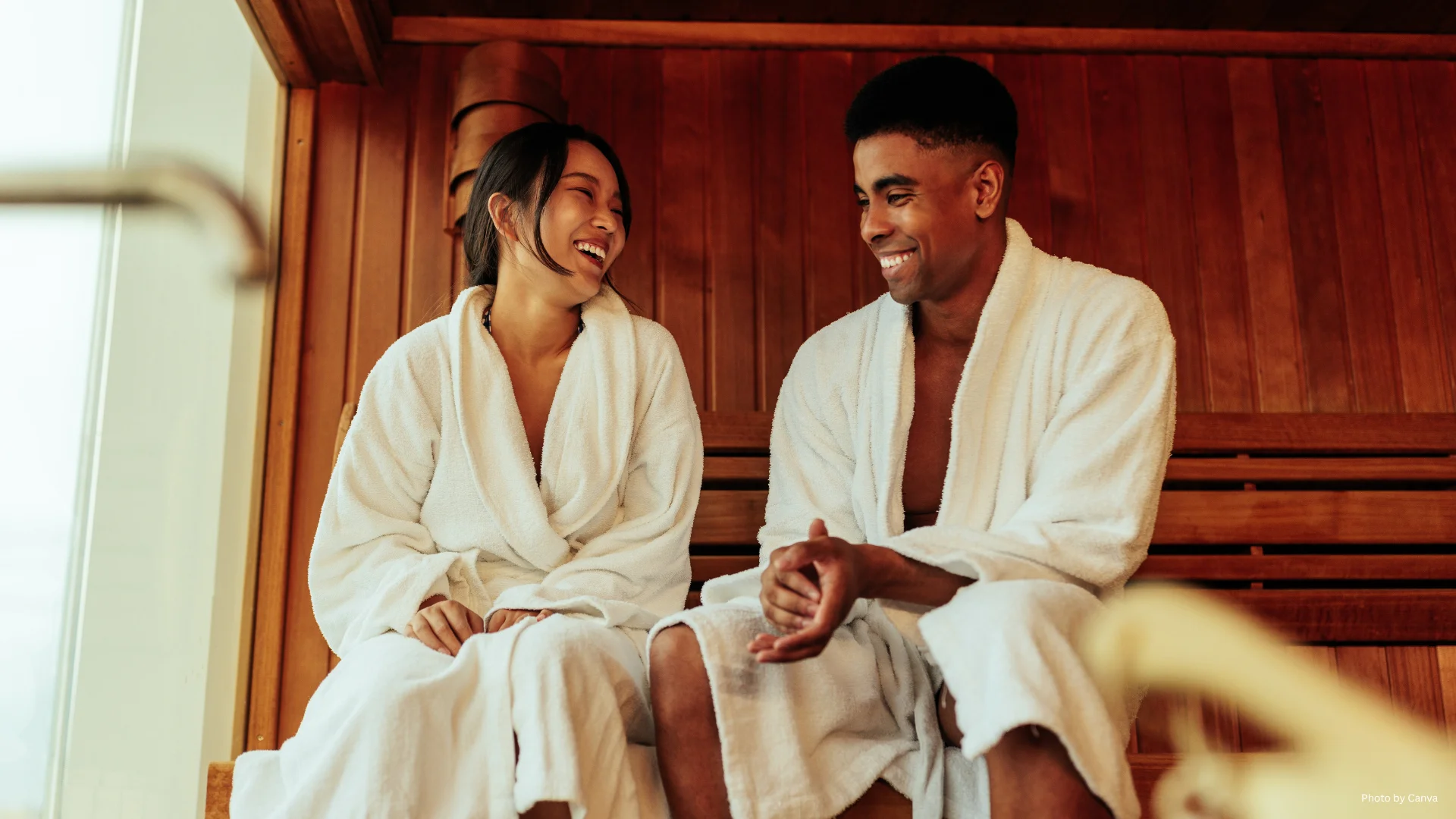
When Klay Thompson, Marcus Smart and D.K. Metcalf joined a group of twenty-eight investors backing a Brooklyn bathhouse, they were betting on more than saunas. The company closed a $35 million round led by Imaginary Ventures in May 2025 and outlined plans for ten locations nationwide, beginning with Los Angeles, Chicago and Nashville. The scale of the investment is striking against the broader market: Grand View Research valued the entire United States sauna market at $250.8 million in 2024. Bathhouse raised an amount equal to roughly 14 percent of that estimated market value in a single financing round.
The expansion is arriving as Americans reconsider where, and how, they socialize. Gallup's July 2026 survey of 1,200 adults found that 54 percent of American adults say they drink alcohol, matching the record low recorded a year earlier in a trend Gallup has tracked for roughly ninety years. Among adults ages eighteen to thirty-four, the rate fell to 50 percent from 59 percent in 2023. Hinge, drawing on a survey of about 30,000 users, reported that 67 percent of Gen Z daters wanted to build romantic connections in the coming year without relying on alcohol.
Bathhouses are positioning themselves to capture some of the social time once routinely spent at bars. The price reflects that ambition. Bathhouse offers a starter membership for $145 a month with three day-pass credits, or roughly $48 per visit, while its standard tier costs $225 a month for five credits. Othership, founded in Toronto in 2018 and now operating locations in Flatiron and Williamsburg, has been reported at $64 for a drop-in session. Its experience includes a communal sauna holding about seventy people at temperatures between 175 and 185 degrees, along with ice baths kept between 32 and 40 degrees for two-minute immersions.
For anyone considering that experience as a date, the relevant question is not whether the room is hot or the plunge is cold. It is which parts of the experience have credible evidence behind them, and which parts are primarily good theater.
The Strongest Sauna Finding Is About Belonging
In 2026, a team led by Martha Newson at the University of Greenwich and the University of Oxford published three studies of sauna culture in the United Kingdom in Social Science and Medicine. The combined sample included 1,907 people, and the researchers went beyond asking whether participants simply felt better after using a sauna. They examined what might be producing those effects.
The first study measured thirty-three people before and after an aufguss ritual, the towel-and-steam performance common in European saunas, and found a large improvement in wellbeing, with a Cohen's d of 1.20. The second surveyed 1,798 people and found that weekly sauna attendance was associated with improved mental health at an odds ratio of 3.14 and improved physical health at 3.40 compared with infrequent attendance. A third study involving seventy-four participants examined the pathway connecting sauna use with those outcomes.
The mediation analysis identified belonging as a significant part of that pathway. Weekly attendance was associated with a stronger sense of belonging, and belonging predicted both physical and mental health outcomes. The researchers described the indirect pathway as particularly robust in the model predicting mental health. Newson summarized the finding directly.
"Sauna has well-evidenced benefits for our physical health, but our research suggests it offers something just as important: connection."
That distinction matters because the cardiovascular research frequently used to market saunas is more limited than many commercial claims suggest. A widely cited Finnish cohort followed 2,315 middle-aged men in Kuopio for a median of 20.7 years. Men who used a sauna four to seven times a week, compared with those who used one once a week, had a hazard ratio of 0.50 for fatal cardiovascular disease and 0.60 for all-cause mortality. The study was observational, included no women and cannot establish that sauna use caused the lower mortality rates.
For dating, the newer research points toward a different feature of the experience. The most relevant evidence is not that heat manufactures intimacy. It is that repeated communal participation can strengthen a sense of connection.
The Evidence for the Cold Plunge Is Much Less Impressive
Cold plunges have become one of the most marketable parts of the modern bathhouse experience, often framed as a rapid way to reduce stress or reset the nervous system. The research is considerably less definitive.
A 2025 systematic review and meta-analysis in PLOS ONE pooled eleven studies involving 3,177 participants and found no significant reduction in stress from cold water immersion immediately afterward, at one hour, at twenty-four hours or at forty-eight hours. The review found a statistically significant reduction at twelve hours, with a standardised mean difference of negative 1.00. It also found no significant difference in mood between participants who underwent cold-water immersion and those who simply rested.
That does not mean an ice bath cannot be memorable. It means the immediate stress-reduction claim is not strongly supported by this review. For a date, the plunge may function more convincingly as a shared challenge than as a proven shortcut to emotional regulation.
The Famous Fear-and-Attraction Study Is Not Strong Evidence Either
Another popular explanation for why an intense experience might make a good date comes from the 1974 suspension bridge experiment by Donald Dutton and Arthur Aron. The study became the foundation for decades of claims that fear or physiological arousal can be misread as romantic attraction. A later statistical reanalysis raises serious questions about how confidently that conclusion should be repeated.
Klaudia Szczucka reanalysed the experiment in the Polish Psychological Bulletin in 2012. Recalculating the phone-number result produced an odds ratio of 1.35 with a confidence interval from 0.345 to 5.284, which was not statistically significant. The corrected callback result reached only p equals .08. Szczucka also noted that the proposed effect failed to replicate in later research by Kenrick and colleagues in 1979 and by Riordan and Tedeschi in 1983.
More useful evidence comes from Aron's later research on established couples. A five-study paper published in the Journal of Personality and Social Psychology in 2000 reported a correlation of .51 between exciting shared activities and relationship quality in a survey sample. The researchers then tested the idea experimentally. Couples who spent seven minutes on a novel and arousing joint task reported greater increases in relationship quality than couples assigned a mundane task across three experiments. The results remained after researchers controlled for social desirability. Novelty and shared effort have better evidence behind them than fear itself.
Bathhouse Operators Are Explicitly Building Social Venues
The companies expanding this category increasingly describe their businesses in social terms rather than treating communal interaction as a side effect of wellness. Amanda Laine, co-founder of Othership, framed the company's appeal as an alternative to conventional nightlife.
"People are tired of going to a bar or restaurant in order to have a social night out; there needs to be a better way."
Jonathan Leary, who founded Remedy Place in West Hollywood in 2019 and later expanded to Flatiron and Boston Seaport, described the same substitution more explicitly. He told Health Club Management that people can celebrate with an ice bath, as opposed to a bottle of wine. Bathhouse co-founder Travis Talmadge has similarly described the sauna as a place designed for people to remain and socialize rather than move through quickly.
The broader wellness industry is making the same bet. The Global Wellness Summit ranked sauna as its second-biggest trend for 2025 and described newer venues as lively, social cultural and entertainment hubs aimed in part at younger consumers seeking in-person connection beyond bars and clubs.
How to Think About a Bathhouse Date
The research supports a more restrained approach than the marketing. There is no evidence here that a hotter sauna automatically produces a stronger bond, or that spending more time in the heat guarantees greater belonging. What the Greenwich work does support is the importance of communal participation, while the aufguss study suggests that a shared ritual can produce a substantial immediate improvement in wellbeing.
That makes the structure of the venue more important than the extremity of the temperatures. A guided sauna round, communal ritual or environment that gives two people time to talk has a stronger research rationale than building the date around repeated cold plunges. The cold-water evidence does not show an immediate stress reduction, so there is little reason to treat the plunge as the centerpiece unless both people genuinely enjoy it.
Price remains part of the calculation. Two visits priced around $48 each put the outing near $100 before anything else is purchased. That places a bathhouse in the same spending range as many dinners and far above simpler dates built around walking or coffee. The wellness date displaced the drinks invitation partly because it offered an activity, a defined time frame and an alternative to alcohol. A bathhouse intensifies that formula by removing two of the most familiar escape valves of an awkward first meeting: the phone and the drink.
That may make the experience a better second or third date than a first one. By then, the novelty measured in Aron's later relationship research becomes an advantage rather than an uncertainty. The practice of handing someone the rope at a climbing gym relies on a similar combination of novelty and shared effort, while our sister site's reporting on work on breathing and nervous system regulation examines another route into deliberate physical calm.
A bathhouse date brings together heat, uninterrupted time, a shared activity and an alcohol-free setting. The strongest evidence does not show that an ice bath creates chemistry or that sauna heat makes two people closer. It suggests that the more interesting part of the experience may be the simplest one: two people participating in something novel, together, long enough to actually pay attention to each other.