
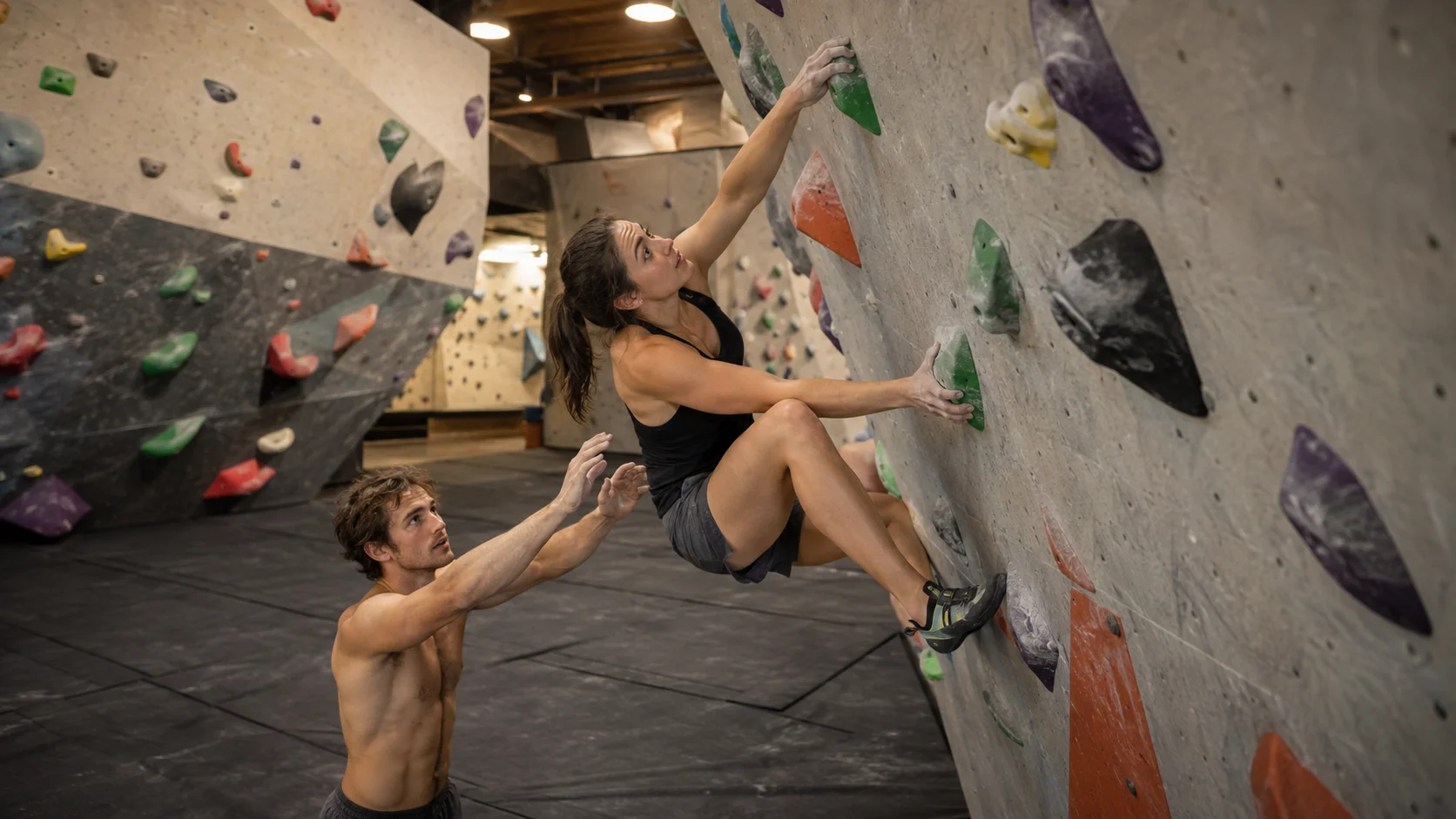
Before anyone climbs anything, two people stand at the base of the wall and inspect each other. One traces the knot at the other's harness with a finger, tugs it, and says the name of the knot out loud. The other looks at the belay device, the carabiner gate, the brake hand, and says the word "on belay." The whole exchange takes about twenty seconds, and it is a more direct conversation about mutual responsibility than most couples manage in their first month.
That ritual is the reason climbing as a first date keeps outperforming the alternatives, and it has surprisingly little to do with fitness. Within ten minutes of meeting, two people are handed a procedure that requires them to check each other's work, admit what they do not know, and then act on the answer while one of them is off the ground. A dinner reservation takes three hours to surface the same information, and often does not.
The short answer for anyone deciding where to take a new person on a Saturday: book the climbing gym. Bouldering, which is climbing at low height over thick mats without ropes, demands nothing but shoes and a willingness to fall. Top-rope climbing adds the belay partnership, which is where the trust actually gets built. Ninety minutes covers an intro class, a harness fitting, and enough climbing to have something to talk about afterward.
What Climbers Say When Researchers Ask Why They Stayed
A team led by Elizabeth Osborne published a qualitative study in PLOS ONE in April 2025, built on semi-structured interviews with thirty indoor climbers aged eighteen to twenty-five in the Intermountain West, conducted between October and December 2023. The researchers were studying well-being, not romance, which is exactly why the findings are useful here.
Participants kept returning to the social architecture of the sport rather than the workout. One described meeting most of their friend group at the wall. Another, an international student, said indoor climbing was what made them feel they belonged in the community at all. The theme the researchers drew out of the belayer and climber relationship was blunt: climbers reported building, in their own words, "really close relationships with people who I can trust."
Trust is a word that gets used loosely in dating advice and precisely in climbing. On the wall it means something measurable, which is that one person has arranged the rope so that a fall stops after a few feet rather than continuing. You cannot perform that. You either did the check or you did not.
The Twenty Seconds That Do the Work
The belay partner check is standardized across nearly every commercial gym in the country, and watching someone run it tells you things a conversation will not. Some people read the laminated card on the wall twice and then ask the staff member to confirm. Some people nod through the instruction and improvise. Neither is a character flaw, but you learn which one you are dealing with in under a minute, and you learn it before anyone has had a drink.
Then there is the moment the climber leans back to be lowered. Every beginner hesitates at that point, because the instruction is to let go of a solid wall and put your weight on a person you met an hour ago. The hesitation is the date. What matters is not whether someone leans back quickly but whether the person on the ground says anything useful while they hesitate.
Climbing also runs on a vocabulary of shared problem solving that has no equivalent in a bar. Two people looking at the same set of holds and disagreeing about the sequence is a low-stakes rehearsal for disagreeing about anything else, and the wall settles the argument without either party having to concede.
Where the Walls Actually Are
The infrastructure is more available than most people assume. Climbing Business Journal counts close to seven hundred commercial climbing facilities operating in the United States, in an industry that has grown every year since the first commercial gym opened in 1987. In the New York metropolitan area alone the tally sits at roughly forty gyms.
Growth has cooled, which matters for anyone shopping on price. CBJ's annual survey recorded fifty-three new gyms opening across North America in 2025, down from sixty the previous year, against twelve permanent closures, all in the United States. Net growth for the continent was 4.7 percent, off from 6.3 percent in 2024. New facilities added 356,314 square feet of climbing surface, a drop of roughly a hundred thousand square feet year over year. One multi-location operator surveyed put the market shift plainly.
Boom times are over. Profitability is much harder unless you have scale and infrastructure to support institutional growth or mergers and acquisitions.
For a first date, a maturing market is good news. Gyms competing for members run intro classes at a discount, bundle the harness and shoe rental into the door price, and staff the floor with people whose job is to make beginners comfortable.
How to Book It Without Turning It Into a Test
Reserve the intro or "learn the ropes" class rather than a day pass. The class costs a few dollars more, includes gear, and hands the teaching job to an instructor, which removes the worst dynamic available on an athletic date, where one person becomes the coach and the other becomes the student.
Go on a weekday evening if you can, because weekend afternoons at popular indoor climbing gyms mean waiting in line at every route. Wear something you can move in and skip the jewelry. Eat first, since climbing is deceptively demanding on the forearms and nobody negotiates a second location well while shaky.
If One of You Climbs and the Other Never Has
The experienced partner should climb less, not more. Set two easy routes, let the beginner work them, and resist narrating technique unless asked. The instinct to demonstrate is the fastest way to convert a date into an audition, and the person who has never touched a wall is already managing enough novelty.
Bouldering solves the asymmetry more elegantly than top rope does, because the problems are graded in tight increments and two people of wildly different ability can work adjacent routes at the same height, talking the whole time. Nobody is stranded on the ground holding a rope.
What the Wall Rewards
Climbing selects for a quality that dating apps have never found a filter for, which is the willingness to be visibly bad at something in front of a person you want to impress. Everyone falls. The route is designed so that you fall, and the sport's entire etiquette exists to make falling unremarkable.
Sports that create this kind of forced interdependence keep outperforming the passive ones, which is the same logic that turned run clubs into a serious meeting ground and pushed the pickleball court onto first-date lists. Climbing takes it a step further by making the interdependence physical and non-negotiable.
There is a body-awareness dividend too. Reading a route trains the same interoceptive skill that yoga practitioners work on deliberately, which is knowing where your limbs are without looking at them. Beginners spend the first session discovering they have no idea, and finding that out beside someone else is considerably less lonely than finding it out alone.
Osborne's participants also described a communal reset, a shift from stressed to energized that happened specifically when they climbed with other people. The researchers concluded that social connection was an important component of well-being for this age group, which is a careful academic way of saying that the rope is not the only thing holding anybody up.
Book the intro class. Learn the knot. Let go of the wall.